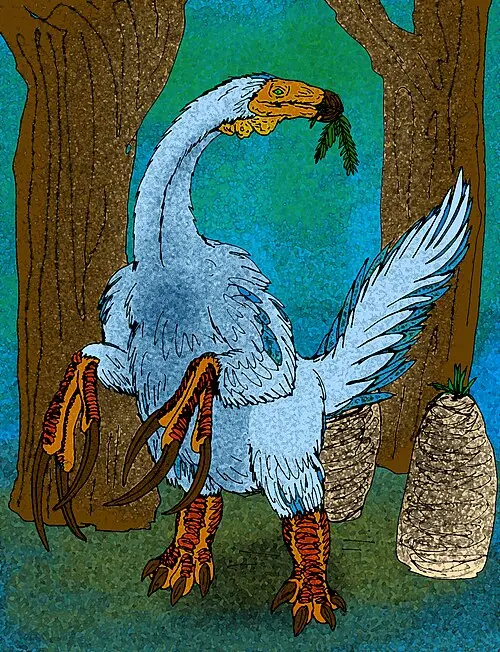
 🎨 Restoration
Restoration: Apokryltaros · CC BY 2.5 · Wikimedia Commons Source
Life restorations are artistic reconstructions based on fossil evidence; true coloration and soft-tissue details remain uncertain.
Therizinosaurus
Therizinosaurus cheloniformis (Therizinosaurus · Therizinosaurus)
Known only from fossils. The IUCN Red List assesses only species extant since 1500 CE, so fossil taxa are not assigned a category.
💡 Everyday Comparisons for Size, Mass & Speed
- 💡 Its estimated body length of about 10 m (representative value for the genus) is slightly shorter than a city bus (about 12 m) (Comparison).
- 💡 Its claws of about 50 cm are more than one and a half times the length of a 30 cm school ruler (Comparison).
Reference standards: coach bus ~12 m, mid-size car ~4.9 m, compact car ~1 t, basketball hoop 3.05 m, credit card 8.56 cm.
📖 1. Overview
Therizinosaurus cheloniformis (genus Therizinosaurus) was a large bipedal plant-eating theropod dinosaur that lived in Mongolia during the Late Cretaceous. Its name means 'scythe lizard.'
🦴 2. Anatomy & Morphology
The claws on its three fingers measured about 50 cm long, possibly the longest of any land animal. Because only its arms, legs, and ribs are known, its overall appearance is reconstructed based on relatives.
🔍 3. Fossil Record & Paleoecology
As a herbivorous dinosaur, it may have used its long claws like an anteater to pull in branches and plants, though whether they were also used as weapons is uncertain. For a long time, researchers debated whether it was a theropod.
🇰🇷 4. Connection to Korea
No direct record connecting this species to Korea has been found.
📚 Sources & References
- • Fossil taxon — the IUCN Red List assesses only species living or extinct since 1500
- • paleobiodb.org — basicTaxonInfo
- • wikidata.org — Q20719444
- • commons.wikimedia.org — File:Therizinosaurus arms.jpg
- • nhm.ac.uk — therizinosaurus.html
- • Silhouette: PhyloPic — Martin Kevil · CC BY 3.0
Recorded dimensions are widely cited representative estimates from public literature and may vary by study or specimen.