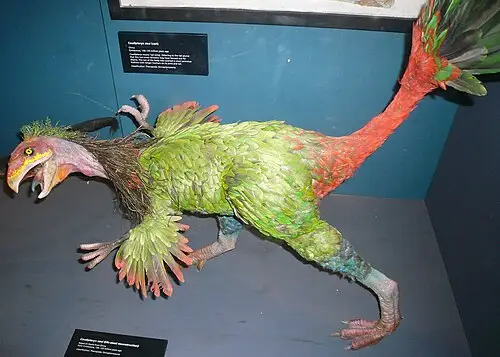
 🎨 Restoration
Restoration: Stanislav Kozlovskiy · CC BY-SA 4.0 · Wikimedia Commons Source
Life restorations are artistic reconstructions based on fossil evidence; true coloration and soft-tissue details remain uncertain.
Caudipteryx
Caudipteryx zoui (Caudipteryx · Caudipteryx)
Known only from fossils. The IUCN Red List assesses only species extant since 1500 CE, so fossil taxa are not assigned a category.
💡 Everyday Comparisons for Size, Mass & Speed
- 💡 An estimated body length of about 1 m (representative value for the genus) is similar to the length of an umbrella, and a weight of about 2 kg is the same as a single 2 L bottle of water (Comparison).
- 💡 The fan-shaped feathers at the tip of its tail bring to mind the tail feathers of modern birds (Comparison).
Reference standards: coach bus ~12 m, mid-size car ~4.9 m, compact car ~1 t, basketball hoop 3.05 m, credit card 8.56 cm.
Site-computed relative index from recorded values; not a formal scientific metric.
📖 1. Overview
Caudipteryx zoui (genus Caudipteryx) was a small bird-like theropod that lived in China during the Early Cretaceous, and its name means "tail feather." It lived in a later period than Archaeopteryx.
🦴 2. Anatomy & Morphology
Feathers were attached like a fan at the tip of its tail, and its small, weak teeth grew only at the front of the upper jaw, pointing outward.
🔍 3. Fossil Record & Paleoecology
Because gastroliths (swallowed stones) were found inside its fossilized body, it is thought to have swallowed stones to aid digestion. Given its weak teeth, it is estimated to have eaten insects and probably plants.
🇰🇷 4. Connection to Korea
No direct record connecting this species to Korea has been found.
📚 Sources & References
- • Fossil taxon — the IUCN Red List assesses only species living or extinct since 1500
- • paleobiodb.org — basicTaxonInfo
- • wikidata.org — Q20717429
- • commons.wikimedia.org — File:Caudipteryx zoui - Untere Kreide - Liaoning-China.jpg
- • nhm.ac.uk — caudipteryx.html
- • Silhouette: PhyloPic — Scott Hartman · CC BY 3.0
Recorded dimensions are widely cited representative estimates from public literature and may vary by study or specimen.