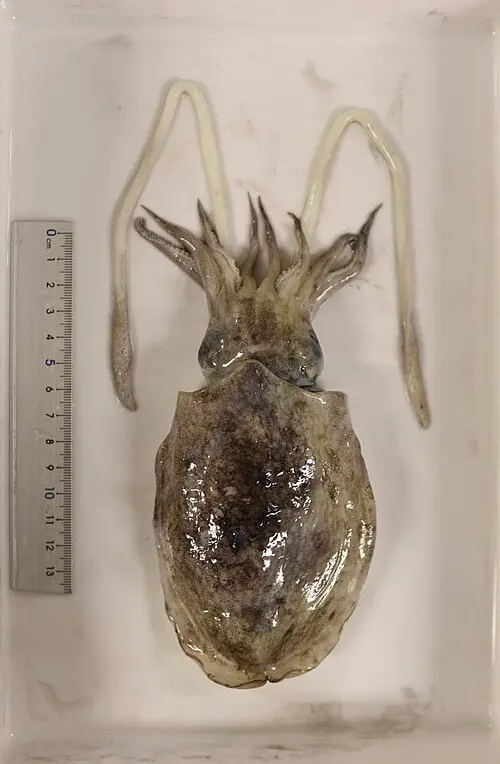
 📸 Photo
Photo: Kingfiser · CC BY-SA 4.0 · Wikimedia Commons Source
Japanese spineless cuttlefish
Sepiella japonica (Japanese spineless cuttlefish · シリヤケイカ)
💡 Everyday Comparisons for Size, Mass & Speed
- 💡 Its maximum weight of 800 g is slightly lighter than a 1 L carton of milk (about 1 kg) (Comparison).
- 💡 Its maximum mantle length of 20 cm is about 2/3 of the long side of an A4 sheet of paper (29.7 cm) (Comparison).
- 💡 In Japan, most of the catch is dried and sold as 'surume', and it is also caught in large numbers by bottom trawls in Korean and Taiwanese fisheries (SeaLifeBase).
Reference standards: coach bus ~12 m, mid-size car ~4.9 m, compact car ~1 t, basketball hoop 3.05 m, credit card 8.56 cm.
Site-computed relative index from recorded values; not a formal scientific metric.
📖 1. Overview
The Japanese spineless cuttlefish is a cuttlefish living on coastal bottoms of the Northwest Pacific from Japan to Korea and China.
🦴 2. Anatomy & Morphology
Its mantle length reaches up to 20 cm and its weight up to about 800 g.
🔍 3. Ecology & Behavior
It lives on coastal bottoms at depths of around 50 m. It is the most abundantly caught cuttlefish off Zhejiang and Jiangsu provinces in China.
🇰🇷 4. Connection to Korea
It is listed on the National List of Species of Korea under the name Soe-gap-ojingeo (Korean name) and is caught in large numbers by bottom trawls in the fisheries of Japan, Korea, and Taiwan.
📚 Sources & References
- • IUCN Red List DD (2012) — https://www.iucnredlist.org/species/162548/913229
- • IUCN Red List category DD — latest assessment at iucnredlist.org
- • marinespecies.org — aphia.php
- • iucnredlist.org — 913229
- • 국가생물종목록(국립생물자원관) ktsn 120000044133 — https://species.nibr.go.kr/home/mainHome.do?cont_link=009&subMenu=009002&contCd=009002&ktsn=120000044133
- • wikidata.org — Q2212414
- • commons.wikimedia.org — File:Sepiella japonica Yawatahama.jpg
- • sealifebase.se — Sepiella-japonica.html
- • Silhouette: PhyloPic — Kurtis Wothe · CC0 1.0 (Related taxon silhouette — Sepiidae)
Recorded dimensions are widely cited representative estimates from public literature and may vary by study or specimen.