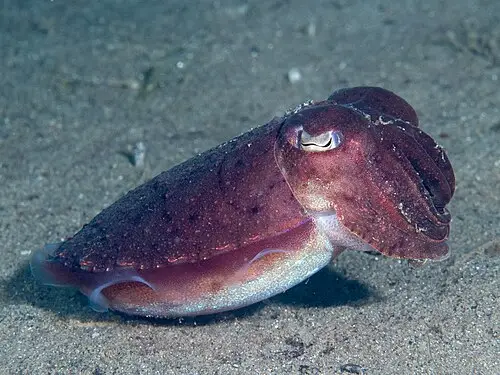
 📸 Photo
Photo: Rickard Zerpe · CC BY 2.0 · Wikimedia Commons Source
Golden cuttlefish
Acanthosepion esculentum (Golden cuttlefish · Golden cuttlefish)
Not Evaluated (NE) on the IUCN Red List yet.
💡 Everyday Comparisons for Size, Mass & Speed
- 💡 Its flesh is a tasty, protein-rich food ingredient, and its internal shell has traditionally been used in medicine (Frontiers in Marine Science).
- 💡 In the food web, it also serves as prey for seabirds, large fish, and marine mammals (Frontiers in Marine Science).
- 💡 Its maximum weight of 600 g is slightly heavier than a 500 mL bottle of water (0.5 kg) (Comparison).
Reference standards: coach bus ~12 m, mid-size car ~4.9 m, compact car ~1 t, basketball hoop 3.05 m, credit card 8.56 cm.
Site-computed relative index from recorded values; not a formal scientific metric.
📖 1. Overview
The golden cuttlefish is a cuttlefish living on shallow seafloors of the western Pacific and is a commercially valuable species in Chinese coastal fisheries.
🦴 2. Anatomy & Morphology
It has an internal shell (cuttlebone) inside its body, with a reported maximum mantle length of 18 cm and maximum weight of 600 g. It sometimes buries itself in bottom sand.
🔍 3. Ecology & Behavior
Carnivorous, juveniles eat crustaceans such as shrimp and crabs, amphipods, and small fish, while adults eat larger shrimp, crabs, and even young cuttlefish, occasionally practicing cannibalism. It usually lives for only 1 year and dies after spawning near the coast around April–July.
🇰🇷 4. Connection to Korea
No direct record connecting this species to Korea has been found.
📚 Sources & References
- • IUCN Red List: not evaluated (NE) — cross-checked with the Wikidata conservation-status entry
- • marinespecies.org — aphia.php
- • commons.wikimedia.org — File:Golden Cuttlefish (Sepia esculenta) (49152874797).jpg
- • sealifebase.se — Sepia-esculenta.html
- • frontiersin.org — full
- • Silhouette: PhyloPic — author not recorded · CC0 1.0 (Congeneric silhouette — Sepia orbignyana)
Recorded dimensions are widely cited representative estimates from public literature and may vary by study or specimen.