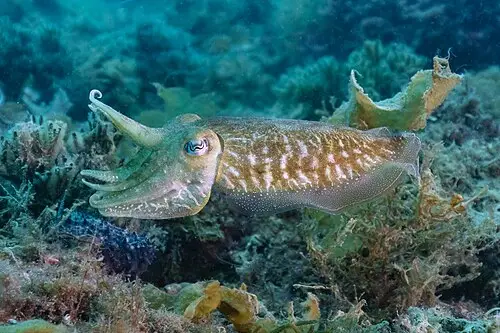
 📸 Photo
Photo: Diego Delso · CC BY-SA 4.0 · Wikimedia Commons Source
Common cuttlefish
Sepia officinalis (Common cuttlefish · ヨーロッパコウイカ)
💡 Everyday Comparisons for Size, Mass & Speed
- 💡 Its maximum weight of 4 kg is 1/5 of a 20 kg bag of rice (Comparison).
- 💡 Its mantle length of 60 cm is the length of two 30 cm rulers placed end to end (Comparison).
- 💡 It is harvested commercially for food, its ink is used for dyes and paint, and its cuttlebone is given to pet birds as a nutritional supplement and to keep their beaks in good condition (ADW positive impacts for humans).
Reference standards: coach bus ~12 m, mid-size car ~4.9 m, compact car ~1 t, basketball hoop 3.05 m, credit card 8.56 cm.
Site-computed relative index from recorded values; not a formal scientific metric.
📖 1. Overview
The common cuttlefish is a cuttlefish living on shallow sea bottoms of the eastern Atlantic and the Mediterranean, famous for its ability to change skin color in an instant.
🦴 2. Anatomy & Morphology
Inside its broad, flattened mantle is an internal shell called a cuttlebone, along with beak-like jaws and large eyes. Special structures in its skin allow it to change color and texture within seconds.
🔍 3. Ecology & Behavior
It hides in sand by day and is active at night, camouflaging itself to match its surroundings as it approaches crustaceans and fish to catch them. It breeds in shallow waters in spring and summer and moves to depths of 100–200 m in autumn and winter.
🇰🇷 4. Connection to Korea
There is no record of this scientific name on the National List of Species of Korea. SeaLifeBase notes that this species is a prized food ingredient in Japan, Korea, Italy, and Spain.
📚 Sources & References
- • IUCN Red List LC (2012) — https://www.iucnredlist.org/species/162664/939991
- • IUCN Red List category LC — latest assessment at iucnredlist.org
- • marinespecies.org — aphia.php
- • iucnredlist.org — 939991
- • wikidata.org — Q756724
- • commons.wikimedia.org — File:Sepia común (Sepia officinalis), Parque natural de la A
- • animaldiversity.org — Sepia officinalis
- • sealifebase.se — Sepia-officinalis.html
- • Silhouette: PhyloPic — David Sim (photograph) and T. Michael Keesey (vectorization) · CC BY 3.0
Recorded dimensions are widely cited representative estimates from public literature and may vary by study or specimen.