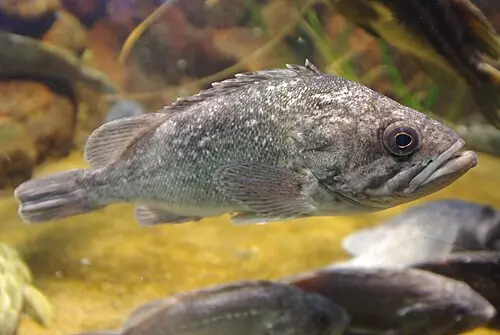
 📸 Photo
Photo: Tomarin · CC BY-SA 2.1 jp · Wikimedia Commons Source
Korean rockfish
Sebastes schlegelii (Korean rockfish · クロソイ)
Not Evaluated (NE) on the IUCN Red List yet.
💡 Everyday Comparisons for Size, Mass & Speed
- 💡 Its maximum weight of 3.1 kg is a little over the weight of two 1.5 L PET bottles (Comparison).
- 💡 It is the most commonly encountered fish at raw fish restaurants in Korea and is eaten raw, grilled, dried, or in spicy soup (National List of Species of Korea).
- 💡 In Korea, it is more commonly called "Ureok" (Korean name) than Jopibollak (Korean name) (National List of Species of Korea).
Reference standards: coach bus ~12 m, mid-size car ~4.9 m, compact car ~1 t, basketball hoop 3.05 m, credit card 8.56 cm.
Site-computed relative index from recorded values; not a formal scientific metric.
📖 1. Overview
The Korean rockfish (Jopibollak, Korean name) is a rockfish living in shallow, rocky coastal waters and is commonly called "Ureok" (Korean name) in Korea. Along with the bastard halibut (Neopchi, Korean name), it is one of Korea's representative farmed fish.
🦴 2. Anatomy & Morphology
It has 3 sharp spines above the upper jaw and 2 stripes below the eye. Its body is grayish-brown with scattered black spots.
🔍 3. Ecology & Behavior
It mainly eats invertebrates and fish. It is viviparous, fertilizing internally from December to February and giving birth to live young in March and April, and juveniles shelter among drifting seaweed.
🇰🇷 4. Connection to Korea
According to the National List of Species of Korea, it inhabits all coastal waters of Korea, and large numbers are released every year, making its stocks abundant.
📚 Sources & References
- • IUCN Red List: not evaluated (NE) — cross-checked with the Wikidata conservation-status entry
- • catalogueoflife.org — 4W7PW
- • 국가생물종목록(국립생물자원관) ktsn 120000058103 — https://species.nibr.go.kr/home/mainHome.do?cont_link=009&subMenu=009002&contCd=009002&ktsn=120000058103
- • wikidata.org — Q1985193
- • commons.wikimedia.org — File:Sebastes schlegelii Hilgendorf, 1880.jpg
- • fishbase.se — Sebastes-schlegelii.html
- • species.nibr.go.kr — mainHome.do
- • Silhouette: PhyloPic — Nathan Hermann · CC0 1.0 (Congeneric silhouette — Sebastes fasciatus)
Recorded dimensions are widely cited representative estimates from public literature and may vary by study or specimen.