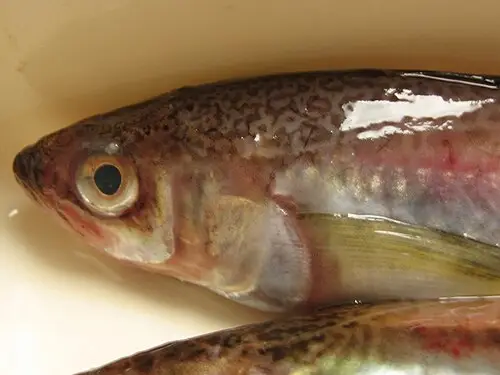
 📸 Photo
Photo: でんぜろ from Japan. · CC BY 2.1 jp · Wikimedia Commons Source
Japanese sandfish
Arctoscopus japonicus (Japanese sandfish · ハタハタ)
Not Evaluated (NE) on the IUCN Red List yet.
💡 Everyday Comparisons for Size, Mass & Speed
- 💡 Its common body length of 20 cm is slightly longer than a pencil, which is about 17.5 cm (Comparison).
- 💡 Its maximum weight of 200 g is just over the weight of three eggs, at about 60 g each (Comparison).
- 💡 In Korea, it can be found north of the central East Sea (National List of Species of Korea).
Reference standards: coach bus ~12 m, mid-size car ~4.9 m, compact car ~1 t, basketball hoop 3.05 m, credit card 8.56 cm.
Site-computed relative index from recorded values; not a formal scientific metric.
📖 1. Overview
The Japanese sandfish is a marine fish living on deep sandy bottoms north of the central East Sea. In Japan, it is bred and released for fisheries.
🦴 2. Anatomy & Morphology
Its body is strongly flattened from side to side, tall in front and tapering toward the back, and has no scales. It has a large snout and eyes with a sharply slanted mouth; its back is yellowish brown with dark brown markings, and its belly is silvery white.
🔍 3. Ecology & Behavior
It mainly feeds on invertebrates. It spawns in November and December among seagrass beds in shallow waters.
🇰🇷 4. Connection to Korea
According to the National List of Species of Korea, it lives in the central and northern East Sea.
📚 Sources & References
- • IUCN Red List: not evaluated (NE) — cross-checked with the Wikidata conservation-status entry
- • catalogueoflife.org — GBKM
- • 국가생물종목록(국립생물자원관) ktsn 120000058878 — https://species.nibr.go.kr/home/mainHome.do?cont_link=009&subMenu=009002&contCd=009002&ktsn=120000058878
- • wikidata.org — Q2386554
- • commons.wikimedia.org — File:Arctoscopus japonicus, -Japan, Dec. 2009 a.jpg
- • fishbase.se — Arctoscopus-japonicus.html
- • species.nibr.go.kr — mainHome.do
Recorded dimensions are widely cited representative estimates from public literature and may vary by study or specimen.