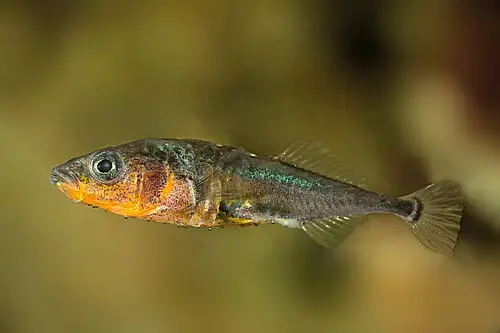
 📸 Photo
Photo: Gilles San Martin · CC BY-SA 2.0 · Wikimedia Commons Source
Three-spined stickleback
Gasterosteus aculeatus (Three-spined stickleback · イトヨ)
💡 Everyday Comparisons for Size, Mass & Speed
- 💡 Its average length of 5 cm is similar to the length of two Korean 500-won coins (2.65 cm in diameter) placed side by side (Comparison).
- 💡 During the breeding season, males change in appearance as their body turns dark blue and their belly turns red (National List of Species of Korea).
- 💡 Because it is easy to raise and experiment with, it is a flagship laboratory animal used in evolutionary and environmental studies (Animal Diversity Web).
Reference standards: coach bus ~12 m, mid-size car ~4.9 m, compact car ~1 t, basketball hoop 3.05 m, credit card 8.56 cm.
📖 1. Overview
The Three-spined stickleback is a small fish widely inhabiting rivers, lakes, estuaries, and coastal seas of the Northern Hemisphere. Its body shape varies greatly depending on its habitat.
🦴 2. Anatomy & Morphology
Its body is spindle-shaped and flattened from side to side, with three sharp spines in front of the dorsal fin and one spine each on the pelvic and anal fins. During the breeding season, males turn dark blue on the body and bright red on the belly.
🔍 3. Ecology & Behavior
It feeds on plankton and small invertebrates such as crustaceans and insect larvae. During the breeding season, the male digs into the bottom, builds a nest out of aquatic plants for females to lay eggs in, and guards it.
🇰🇷 4. Connection to Korea
According to the National List of Species of Korea, it lives in the Nakdonggang River and rivers along the East Sea coast, and spawns from March to May.
📚 Sources & References
- • IUCN Red List LC (2024) — https://www.iucnredlist.org/species/225345695/176077275
- • IUCN Red List category LC — latest assessment at iucnredlist.org
- • catalogueoflife.org — 3FCKT
- • iucnredlist.org — 176077275
- • 국가생물종목록(국립생물자원관) ktsn 120000058005 — https://species.nibr.go.kr/home/mainHome.do?cont_link=009&subMenu=009002&contCd=009002&ktsn=120000058005
- • wikidata.org — Q203572
- • commons.wikimedia.org — File:Gasterosteus aculeatus - Epinoche - Three-spined stickl
- • fishbase.se — Gasterosteus-aculeatus.html
- • species.nibr.go.kr — mainHome.do
- • animaldiversity.org — Gasterosteus aculeatus
- • Silhouette: PhyloPic — Ingo Braasch · CC0 1.0
Recorded dimensions are widely cited representative estimates from public literature and may vary by study or specimen.