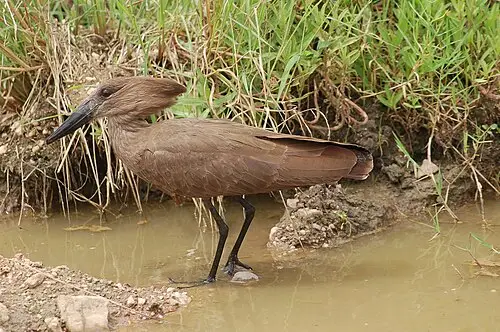
 📸 Photo
Photo: Joachim Huber · CC BY-SA 2.0 · Wikimedia Commons Source
Hamerkop
Scopus umbretta (Hamerkop · シュモクドリ)
💡 Everyday Comparisons for Size, Mass & Speed
- 💡 Its weight of about 1 pound (0.45 kg) is similar to a 500 mL bottle of water (Comparison).
- 💡 Its nest is 6–8 feet across (around 2 m) and weighs up to 50 pounds (about 23 kg), strong enough to support a person standing on it and making it the largest bird nest in Africa (Oregon Zoo).
- 💡 Entered through a single tunnel opening, this nest is sometimes shared with other birds, snakes, or bees (Oregon Zoo).
Reference standards: coach bus ~12 m, mid-size car ~4.9 m, compact car ~1 t, basketball hoop 3.05 m, credit card 8.56 cm.
📖 1. Overview
The Hamerkop is a waterbird with a backward-pointing crest and a hammer-like bill. It lives in sub-Saharan Africa and the southwestern tip of the Arabian Peninsula.
🦴 2. Anatomy & Morphology
As its name suggests, it is characterized by a crest protruding from the back of its head and a hammer-shaped bill. It is skilled at spreading its wide wings to soar and glide.
🔍 3. Ecology & Behavior
It eats worms, insects, frogs, and small fish, splashing water and flapping its wings to flush prey or gliding over the water to snatch fish. It lays 3–7 eggs, incubates them for about 30 days, and chicks can fly after about 50 days.
🇰🇷 4. Connection to Korea
No direct record connecting this species to Korea has been found.
📚 Sources & References
- • IUCN Red List LC (2025) — https://www.iucnredlist.org/species/22697356/265021380
- • IUCN Red List category LC — latest assessment at iucnredlist.org
- • doi.org — avilist.v2026
- • iucnredlist.org — 265021380
- • wikidata.org — Q652151
- • commons.wikimedia.org — File:Scopus umbretta -Serengeti, Tanzania-8.jpg
- • oregonzoo.org — hamerkop
- • Silhouette: PhyloPic — Arthur Grosset (photo), John E. McCormack, Michael G. Harvey, Brant C. Faircloth, Nicholas G. Crawford, Travis C. Glenn, Robb T. Brumfield & T. Michael Keesey · CC BY 3.0
Recorded dimensions are widely cited representative estimates from public literature and may vary by study or specimen.