 📸 Photo
Photo: https://www.flickr.com/photos/zeroexposure/ · CC BY 2.0 · Wikimedia Commons Source
Shoebill
Balaeniceps rex (Shoebill · ハシビロコウ)
💡 Everyday Comparisons for Size, Mass & Speed
- 💡 Its standing height of 1.4 m is similar to the height of a 5th-grade elementary school child (Comparison).
- 💡 Growing numbers of tourists on wildlife excursions along African rivers come to see this bird, bringing income to local regions (Animal Diversity Web).
- 💡 Local people also catch it for food or sell it to zoos (Animal Diversity Web).
Reference standards: coach bus ~12 m, mid-size car ~4.9 m, compact car ~1 t, basketball hoop 3.05 m, credit card 8.56 cm.
📖 1. Overview
The shoebill is a large African waterbird famous for its huge, shoe-shaped bill. It lives in freshwater swamps and dense marshes.
🦴 2. Anatomy & Morphology
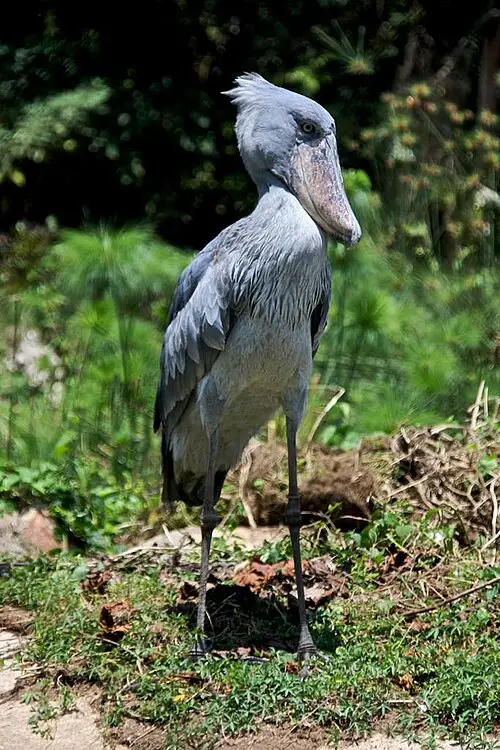
Its body is slaty blue-grey with a small crest that rises at the back of the head. The bill is large and wide like a wooden shoe, and males are larger than females with longer bills.
🔍 3. Ecology & Behavior
It mainly eats lungfish, catfish, tilapia, and watersnakes, and sometimes catches frogs, monitor lizards, and young crocodiles. It hunts by standing still and waiting or by walking slowly, and during the breeding season it defends a territory of about 3 km².
🇰🇷 4. Connection to Korea
No direct record connecting this species to Korea has been found.
📚 Sources & References
- • IUCN Red List VU (2018) — https://www.iucnredlist.org/species/22697583/133840708
- • IUCN Red List category VU — latest assessment at iucnredlist.org
- • doi.org — avilist.v2026
- • iucnredlist.org — 133840708
- • wikidata.org — Q18700
- • commons.wikimedia.org — File:Entebbe Shoe Bill Stork.jpg
- • animaldiversity.org — Balaeniceps rex
- • Silhouette: PhyloPic — Tom Tarrant (photo), John E. McCormack, Michael G. Harvey, Brant C. Faircloth, Nicholas G. Crawford, Travis C. Glenn, Robb T. Brumfield & T. Michael Keesey · CC BY 3.0
Recorded dimensions are widely cited representative estimates from public literature and may vary by study or specimen.