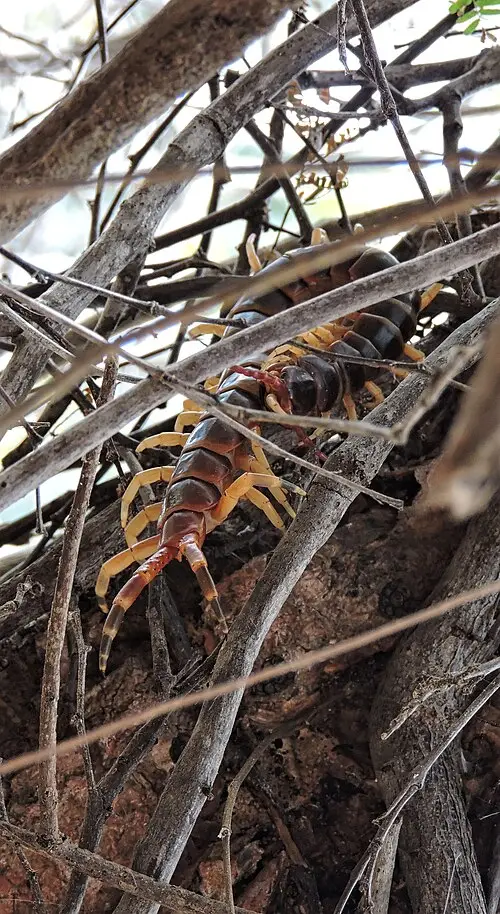
 📸 Photo
Photo: Ginelly.Q · CC0 · Wikimedia Commons Source
Amazonian giant centipede
Scolopendra gigantea (Amazonian giant centipede · ペルビアンジャイアントオオムカデ)
Not Evaluated (NE) on the IUCN Red List yet.
💡 Everyday Comparisons for Size, Mass & Speed
- 💡 A maximum body length of about 30 cm is the same length as a 30 cm ruler (Comparison).
- 💡 Animal Diversity Web explains that centipedes benefit gardeners and farmers by preying on pests, and notes that centipedes are becoming popular terrarium pets. There are also records of this species preying on bats.
Reference standards: coach bus ~12 m, mid-size car ~4.9 m, compact car ~1 t, basketball hoop 3.05 m, credit card 8.56 cm.
📖 1. Overview
The Amazonian giant centipede is the world's largest tropical centipede, living in northern Colombia and Venezuela and on the islands of Margarita, Trinidad, Curaçao, and Aruba.
🦴 2. Anatomy & Morphology
Its flattened body has one pair of legs per segment, totaling 21 or 23 pairs of legs. Its head is dark brown to reddish brown, its legs are olive green with yellow claws, and the first pair of legs is modified into venom-injecting fangs (forcipules).
🔍 3. Ecology & Behavior
Active at night, it is a carnivore that preys on snails, spiders, insects, and earthworms as well as birds, frogs, mice, and even bats. With poor eyesight, it locates prey using its antennae and immediately injects venom with its fangs upon contact to paralyze it.
🇰🇷 4. Connection to Korea
No direct record connecting this species to Korea has been found.
📚 Sources & References
- • IUCN Red List: not evaluated (NE) — cross-checked with the Wikidata conservation-status entry
- • catalogueoflife.org — 6XXFR
- • wikidata.org — Q1319163
- • commons.wikimedia.org — File:Lisimbein di Aruba.jpg
- • sta.uwi.edu — Scolopendra gigantea - Giant Centipede.pdf
- • animaldiversity.org — Scolopendra gigantea
- • Silhouette: PhyloPic — author not recorded · CC0 1.0
Recorded dimensions are widely cited representative estimates from public literature and may vary by study or specimen.