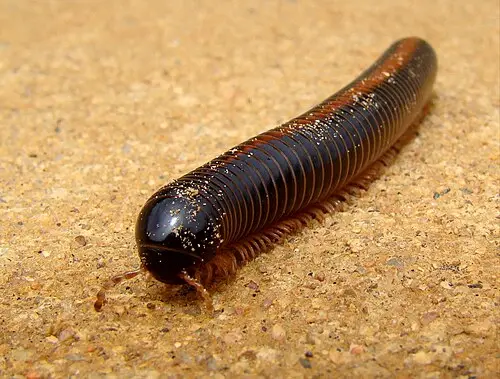
 📸 Photo
Photo: Bjørn Christian Tørrissen · CC BY-SA 3.0 · Wikimedia Commons Source
Giant African millipede
Archispirostreptus gigas (Giant African millipede · アフリカオオヤスデ)
💡 Everyday Comparisons for Size, Mass & Speed
- 💡 Its maximum body length of 12 inches (about 30 cm) is the same length as a single 30 cm ruler.
- 💡 The Buffalo Zoo notes that this millipede's droppings act as fertilizer, helping tropical rainforest plants grow. The San Diego Zoo explains that unlike centipedes, millipedes lack venomous fangs and cannot bite, so when threatened they coil up and release a foul-smelling liquid.
Reference standards: coach bus ~12 m, mid-size car ~4.9 m, compact car ~1 t, basketball hoop 3.05 m, credit card 8.56 cm.
📖 1. Overview
The giant African millipede (Archispirostreptus gigas) is one of the largest millipede species, living in warm, dark areas on the floor of African tropical rainforests. The IUCN Red List assessed it as Least Concern (LC) in 2021.
🦴 2. Anatomy & Morphology
Its cylindrical body is brown or black with more than 40 segments, and with two pairs (four legs) per segment, it has about 300 to 400 legs in total. Each time it molts, it adds one segment and four legs.
🔍 3. Ecology & Behavior
It is a nocturnal decomposer that feeds on decaying organic matter such as dead wood and plants. When threatened, it coils its body into a spiral and secretes a foul-smelling, distasteful fluid from each segment; its jaws are weak and cannot bite.
🇰🇷 4. Connection to Korea
No direct record connecting this species to Korea has been found.
📚 Sources & References
- • IUCN Red List LC (2021) — https://www.iucnredlist.org/species/103866629/103877116
- • IUCN Red List category LC — latest assessment at iucnredlist.org
- • catalogueoflife.org — G9Q6
- • iucnredlist.org — 103877116
- • wikidata.org — Q1954820
- • commons.wikimedia.org — File:Archispirostreptus-Gigas-Amphitheatre.jpg
- • animals.sandiegozoo.org — giant-african-millipede
- • buffalozoo.org — giant-african-millipede
- • Silhouette: PhyloPic — author not recorded · CC0 1.0
Recorded dimensions are widely cited representative estimates from public literature and may vary by study or specimen.