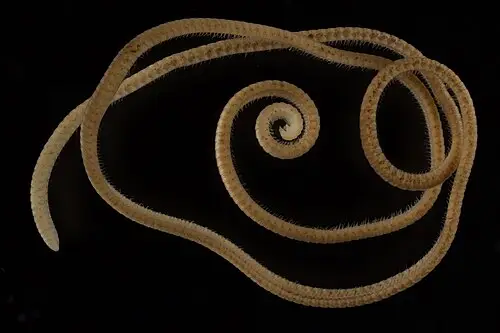
 📸 Photo
Photo: Aggyrolemnoixytes /Paul Marek · CC BY 4.0 · Wikimedia Commons Source
Eumillipes persephone
Eumillipes persephone (Eumillipes persephone · エウミリペス・ペルセフォン)
Not Evaluated (NE) on the IUCN Red List yet.
💡 Everyday Comparisons for Size, Mass & Speed
- 💡 Its body length of 95.7 mm is about 1 cm longer than the long side of a credit card (about 8.6 cm), and its width of 0.95 mm is about twice the thickness of a 0.5 mm mechanical pencil lead (Comparison).
- 💡 Researchers state that no millipede had previously been known to have more than 750 legs. Although the word 'millipede' means 'a thousand legs,' this species is introduced as the first to surpass a thousand with 1,306 legs.
Reference standards: coach bus ~12 m, mid-size car ~4.9 m, compact car ~1 t, basketball hoop 3.05 m, credit card 8.56 cm.
📖 1. Overview
Eumillipes persephone is a slender millipede discovered in Western Australia that has 1,306 legs, making it the millipede recorded with the most legs.
🦴 2. Anatomy & Morphology
Its slender body is 95.7 mm long and 0.95 mm wide, with 330 segments. Its cone-shaped head bears large antennae and a beak for feeding, and it lacks eyes and pigment.
🔍 3. Ecology & Behavior
It is a cave- and subterranean-dwelling (troglomorphic) millipede discovered 60 m underground in a borehole drilled for mineral exploration. Because mining development is active in the region, researchers note that documenting this species and conserving its habitat are important.
🇰🇷 4. Connection to Korea
No direct record connecting this species to Korea has been found.
📚 Sources & References
- • IUCN Red List: not evaluated (NE) — cross-checked with the Wikidata conservation-status entry
- • catalogueoflife.org — 8TFYP
- • wikidata.org — Q110155010
- • commons.wikimedia.org — File:The leggiest animal on the planet, Eumillipes persephon
- • pmc.ncbi.nlm.nih.gov — PMC8677783
Recorded dimensions are widely cited representative estimates from public literature and may vary by study or specimen.