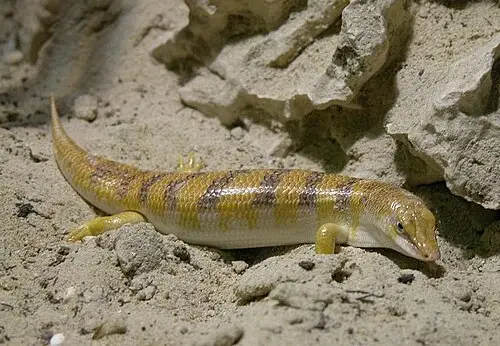
 📸 Photo
Photo: Wilfried Berns · CC BY-SA 2.0 de · Wikimedia Commons Source
Sandfish Skink
Scincus scincus (Sandfish Skink · スナトカゲ)
💡 Everyday Comparisons for Size, Mass & Speed
- 💡 An average length of 8.9 cm is almost the same as the long side of a credit card (about 8.6 cm) (Comparison).
- 💡 An average weight of 16.6 g is slightly heavier than two Korean 500-won coins (about 15.4 g) (Comparison).
- 💡 It is used in studies of body plans and lung structures adapted for desert survival, helping researchers understand organisms that move through sand (positive impacts on humans in ADW).
Reference standards: coach bus ~12 m, mid-size car ~4.9 m, compact car ~1 t, basketball hoop 3.05 m, credit card 8.56 cm.
Site-computed relative index from recorded values; not a formal scientific metric.
📖 1. Overview
The Sandfish Skink is a small lizard that burrows through desert sand as if swimming.
🦴 2. Anatomy & Morphology
It has a flat, wide body with four limbs, a shovel-shaped snout, and specialized structures that allow it to breathe even under sand.
🔍 3. Ecology & Behavior
Using its shovel-like snout and flat body to move through sand as if swimming, it is an insectivore that detects prey from vibrations on the sand surface. Its diet consists of insects including crickets and mealworms, and it breeds in months 5–7 after rain.
🇰🇷 4. Connection to Korea
No direct record connecting this species to Korea has been found.
📚 Sources & References
- • IUCN Red List LC (2021) — https://www.iucnredlist.org/species/164624/1062266
- • IUCN Red List category LC — latest assessment at iucnredlist.org
- • catalogueoflife.org — 4VK6R
- • iucnredlist.org — 1062266
- • wikidata.org — Q620576
- • commons.wikimedia.org — File:Apothekerskink01.jpg
- • animaldiversity.org — Scincus scincus
- • Silhouette: PhyloPic — Gopal Murali · CC0 1.0 (Related taxon silhouette — Sphenomorphus dussumieri)
Recorded dimensions are widely cited representative estimates from public literature and may vary by study or specimen.