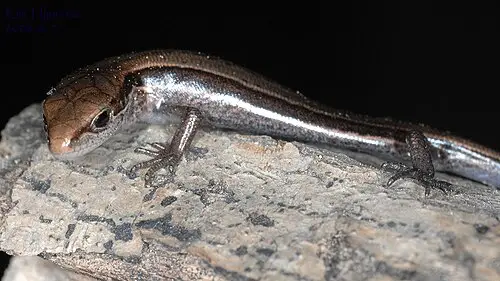
 📸 Photo
Photo: Kim, Hyun-tae · CC BY 4.0 · Wikimedia Commons Source
Huanren Ground Skink
Scincella huanrenensis (Huanren Ground Skink · Huanren Ground Skink)
💡 Everyday Comparisons for Size, Mass & Speed
- 💡 With fewer than 15 populations known in Korea, every mountain slope where this lizard lives is important for conservation.
- 💡 There is a study that sequenced the mitochondrial genome from an individual collected in Pyeongchang-gun, Gangwon-do.
Reference standards: coach bus ~12 m, mid-size car ~4.9 m, compact car ~1 t, basketball hoop 3.05 m, credit card 8.56 cm.
📖 1. Overview
The Huanren Ground Skink is a small lizard living in Liaoning, China, and the northeastern mountains of Korea, classified as Critically Endangered (CR) by the IUCN.
🦴 2. Anatomy & Morphology
It is a small skink in the family Scincidae and, unusually among East Asian species of its genus, is ovoviviparous, hatching its eggs inside the body to give birth to live young. Reliable body size figures have not yet been confirmed.
🔍 3. Ecology & Behavior
It belongs to the group of small diurnal lizards that eat insects and spiders. In Korea, fewer than 15 populations are known.
🇰🇷 4. Connection to Korea
In Korea, it is known only from the northeast, including Gangwon-do, Gyeonggi-do, and Gyeongsangbuk-do. A table in one study lists it as Near Threatened (NT) on the National Red List of Korea, with 30 confirmed domestic localities.
📚 Sources & References
- • IUCN Red List CR (2019) — https://www.iucnredlist.org/species/102656174/102656452
- • IUCN Red List category CR — latest assessment at iucnredlist.org
- • catalogueoflife.org — 4VK2T
- • iucnredlist.org — 102656452
- • 국가생물종목록(국립생물자원관) ktsn 120000059469 — https://species.nibr.go.kr/home/mainHome.do?cont_link=009&subMenu=009002&contCd=009002&ktsn=120000059469
- • wikidata.org — Q3475858
- • commons.wikimedia.org — File:Scincella huanrenensis 2800143.jpg
- • reptile-database.reptarium.cz — species
- • pmc.ncbi.nlm.nih.gov — PMC7800236
- • pmc.ncbi.nlm.nih.gov — PMC9436999
- • pmc.ncbi.nlm.nih.gov — PMC9816106
- • species.nibr.go.kr — general-search
- • Silhouette: PhyloPic — Gopal Murali · CC0 1.0 (Related taxon silhouette — Sphenomorphus dussumieri)
Recorded dimensions are widely cited representative estimates from public literature and may vary by study or specimen.