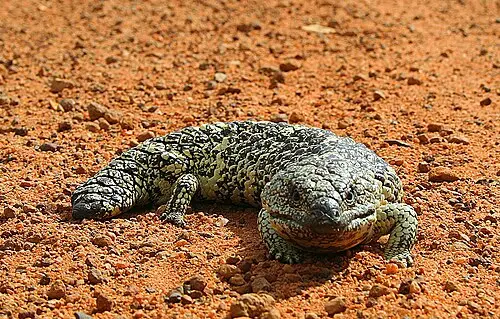
 📸 Photo
Photo: Bäras · CC BY-SA 3.0 · Wikimedia Commons Source
Shingleback Lizard
Tiliqua rugosa (Shingleback Lizard · マツカサトカゲ)
💡 Everyday Comparisons for Size, Mass & Speed
- 💡 It was a good food source for Indigenous Australians and was used medicinally by some tribes, and export from Australia is prohibited (positive impacts on humans in ADW).
- 💡 An adult's maximum weight of 900 g is about the weight of three blocks of store-bought tofu (Comparison).
Reference standards: coach bus ~12 m, mid-size car ~4.9 m, compact car ~1 t, basketball hoop 3.05 m, credit card 8.56 cm.
Site-computed relative index from recorded values; not a formal scientific metric.
📖 1. Overview
The Shingleback Lizard is a large lizard living in semi-arid regions of Australia, characterized by large scales that look like a pine cone.
🦴 2. Anatomy & Morphology
Its short, blunt tail looks similar to its head, which can fool predators. The scales on its body and tail are large and knobby, resembling a pine cone.
🔍 3. Ecology & Behavior
An opportunistic omnivore that mainly eats herbs, young shoots, flowers, and fruit, as well as insects, snails, and carrion. It is viviparous, giving birth to 1–2 young at a time, and newborn young already weigh 60–140 g.
🇰🇷 4. Connection to Korea
No direct record connecting this species to Korea has been found.
📚 Sources & References
- • IUCN Red List LC (2017) — https://www.iucnredlist.org/species/109481513/109481530
- • IUCN Red List category LC — latest assessment at iucnredlist.org
- • catalogueoflife.org — 56X25
- • iucnredlist.org — 109481530
- • wikidata.org — Q572677
- • commons.wikimedia.org — File:Tannenzapfenskink (cropped).jpg
- • animaldiversity.org — Tiliqua rugosa
- • Silhouette: PhyloPic — Kailah Thorn & Mark Hutchinson · CC0 1.0
Recorded dimensions are widely cited representative estimates from public literature and may vary by study or specimen.