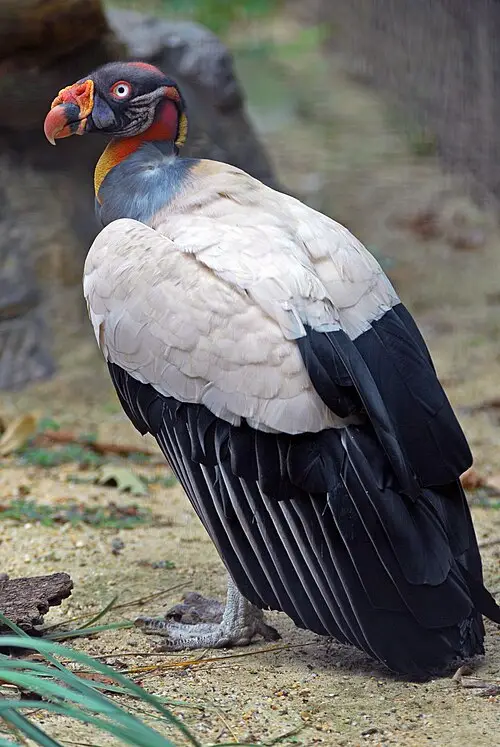
 📸 Photo
Photo: Eric Kilby · CC BY-SA 2.0 · Wikimedia Commons Source
King Vulture
Sarcoramphus papa (King Vulture · トキイロコンドル)
💡 Everyday Comparisons for Size, Mass & Speed
- 💡 Its height of 0.8 m is about the height of an ordinary desk, and its wingspan of 1.98 m is slightly taller than a grown adult (Comparison).
- 💡 Thanks to its large size and striking colors, it is a popular attraction at zoos (ADW 'Economic Importance for Humans: Positive').
Reference standards: coach bus ~12 m, mid-size car ~4.9 m, compact car ~1 t, basketball hoop 3.05 m, credit card 8.56 cm.
Site-computed relative index from recorded values; not a formal scientific metric.
📖 1. Overview
The King Vulture is a large scavenger bird with a mostly white body that lives in lowland tropical forests from southern Mexico to southern Argentina. Because it lives high in the forest canopy, its life in the wild is poorly known.
🦴 2. Anatomy & Morphology
Its wings and body are mostly white with black wingtips and tail feathers. Its bare head and neck are brightly colored in red, orange, and yellow, and its hooked beak is sharp and strong.
🔍 3. Ecology & Behavior
It eats only dead animals and does not kill living prey. It soars high in the sky waiting for smaller vultures to locate carrion before swooping down to take over, and instead of building a nest, it lays usually one egg in a rotting log hollow or tree crevice.
🇰🇷 4. Connection to Korea
No direct record connecting this species to Korea has been found.
📚 Sources & References
- • IUCN Red List LC (2023) — https://www.iucnredlist.org/species/22697645/228983760
- • IUCN Red List category LC — latest assessment at iucnredlist.org
- • doi.org — avilist.v2026
- • iucnredlist.org — 228983760
- • wikidata.org — Q192705
- • commons.wikimedia.org — File:Sarcoramphus papa -National Zoo -Washington -USA-8a.jpg
- • animaldiversity.org — Sarcoramphus papa
- • nationalzoo.si.edu — king-vulture
- • Silhouette: PhyloPic — Andy Wilson · CC0 1.0
Recorded dimensions are widely cited representative estimates from public literature and may vary by study or specimen.