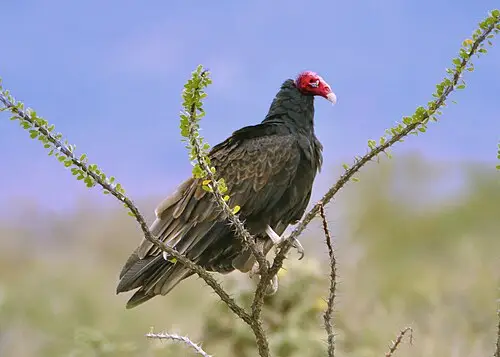
 📸 Photo
Photo: Andrey from Finland · CC BY 2.0 · Wikimedia Commons Source
Turkey Vulture
Cathartes aura (Turkey Vulture · ヒメコンドル)
💡 Everyday Comparisons for Size, Mass & Speed
- 💡 Its wingspan of 1.83 m is about the height of an adult, and its maximum mass of 2 kg is similar to one 2 L bottle of water (Comparison).
- 💡 By clearing roadkill and livestock carcasses, it removes dead animals that could pose a health risk to humans and livestock (ADW, 'Economic Importance for Humans: Positive').
Reference standards: coach bus ~12 m, mid-size car ~4.9 m, compact car ~1 t, basketball hoop 3.05 m, credit card 8.56 cm.
Site-computed relative index from recorded values; not a formal scientific metric.
📖 1. Overview
The turkey vulture is a scavenger bird widespread across the Americas that lives wherever carrion is available—in forests or open country—and adapts well to human-made environments. There are three subspecies in North America and three in Central and South America.
🦴 2. Anatomy & Morphology
Its body length is 64–81 cm and its wingspan is 170–183 cm. It uses both keen smell and sharp vision to locate food.
🔍 3. Ecology & Behavior
It feeds on dead animals, eating mainly livestock carcasses around farms and roadkill in developed areas. It searches for food alone by day and may roost in groups of hundreds at night, with populations in cold regions migrating seasonally to warmer areas.
🇰🇷 4. Connection to Korea
No direct record connecting this species to Korea has been found.
📚 Sources & References
- • IUCN Red List LC (2018) — https://www.iucnredlist.org/species/22697627/131941613
- • IUCN Red List category LC — latest assessment at iucnredlist.org
- • doi.org — avilist.v2026
- • iucnredlist.org — 131941613
- • wikidata.org — Q245181
- • commons.wikimedia.org — File:Cathartes aura -Mexico-8.jpg
- • animaldiversity.org — Cathartes aura
- • Silhouette: PhyloPic — Andy Wilson · CC0 1.0
Recorded dimensions are widely cited representative estimates from public literature and may vary by study or specimen.