 📸 Photo
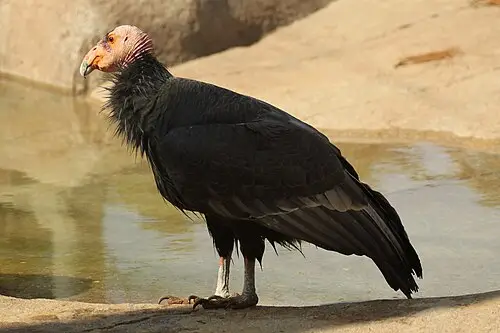
Photo: Stacy from San Diego · CC BY 2.0 · Wikimedia Commons Source
California Condor
Gymnogyps californianus (California Condor · カリフォルニアコンドル)
💡 Everyday Comparisons for Size, Mass & Speed
- 💡 Its wingspan of 2.8 m is longer than the ceiling height of a typical room (about 2.3 m) (Comparison).
- 💡 Its weight of 11 kg is slightly heavier than a 10 kg bag of rice (Comparison).
- 💡 Its greatest threat is lead poisoning from eating carcasses containing fragments of lead ammunition used by hunters.
Reference standards: coach bus ~12 m, mid-size car ~4.9 m, compact car ~1 t, basketball hoop 3.05 m, credit card 8.56 cm.
Site-computed relative index from recorded values; not a formal scientific metric.
📖 1. Overview
The California Condor is a very large vulture living in western North America; it is a Critically Endangered species that declined to 22 individuals in 1982 before recovering to over 500 birds through breeding programs.
🦴 2. Anatomy & Morphology
Adults have a reddish-orange head while juveniles have a dark head. Its body is black with large white patches on the undersides of the wings, and because it cannot sweat, it defecates on its own legs to cool down.
🔍 3. Ecology & Behavior
Rather than hunting, it flies over wide areas to feed on carcasses of animals such as sheep, deer, and cattle. It lays its egg directly on the floor of a cliff cave without a nest, raises about one chick every 2 years, and can live for over 50 years.
🇰🇷 4. Connection to Korea
No direct record connecting this species to Korea has been found.
📚 Sources & References
- • IUCN Red List CR (2020) — https://www.iucnredlist.org/species/22697636/181151405
- • IUCN Red List category CR — latest assessment at iucnredlist.org
- • doi.org — avilist.v2026
- • iucnredlist.org — 181151405
- • wikidata.org — Q194314
- • commons.wikimedia.org — File:Gymnogyps californianus -San Diego Zoo-8a.jpg
- • peregrinefund.org — california-condor
- • animaldiversity.org — Gymnogyps californianus
- • Silhouette: PhyloPic — Andy Wilson · CC0 1.0
Recorded dimensions are widely cited representative estimates from public literature and may vary by study or specimen.