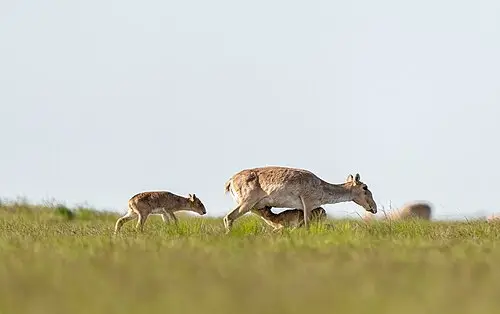
 📸 Photo
Photo: Dildakhmet · CC BY-SA 4.0 · Wikimedia Commons Source
Saiga
Saiga tatarica (Saiga · サイガ)
💡 Everyday Comparisons for Size, Mass & Speed
- 💡 Its horns are ground into powder and used in traditional Chinese medicine to reduce fevers.
- 💡 Its maximum body length of 1.5 m is 1/3 the length of a passenger car (about 4.5 m) (Comparison).
- 💡 Its weight of 45 kg is equal to two and a half 20 kg bags of rice (Comparison).
Reference standards: coach bus ~12 m, mid-size car ~4.9 m, compact car ~1 t, basketball hoop 3.05 m, credit card 8.56 cm.
Site-computed relative index from recorded values; not a formal scientific metric.
📖 1. Overview
The Saiga is an antelope of dry grasslands, instantly recognizable by its large overhanging nose. Though it resembles a small sheep, its snout and horns are unmistakable.
🦴 2. Anatomy & Morphology
It has a large head with a huge nose hanging over its mouth, and only males bear ringed, waxy-colored horns. Its summer coat is yellowish red, changing in winter to long, thick gray fur.
🔍 3. Ecology & Behavior
It grazes on over a hundred species of grasses, sagebrush, and lichens. During the breeding season, a single male defends a harem of 5–10 females, and females usually give birth to two young.
🇰🇷 4. Connection to Korea
No direct record connecting this species to Korea has been found.
📚 Sources & References
- • IUCN Red List NT (2023) — https://www.iucnredlist.org/species/19832/233712210
- • IUCN Red List category NT — latest assessment at iucnredlist.org
- • mammaldiversity.org — 1006176
- • iucnredlist.org — 233712210
- • wikidata.org — Q126683
- • commons.wikimedia.org — File:Saiga tatarica, Bokeiorda Reserve, Kazakhstan DIL00119.
- • animaldiversity.org — Saiga tatarica
- • Silhouette: PhyloPic — Trent Sperry · CC0 1.0
Recorded dimensions are widely cited representative estimates from public literature and may vary by study or specimen.