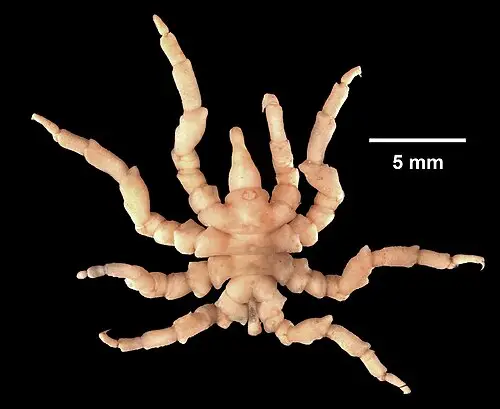
 📸 Photo
Photo: Eric A. Lazo-Wasem · CC0 · Wikimedia Commons Source
Littoral sea spider
Pycnogonum litorale (Littoral sea spider · Littoral sea spider)
Not Evaluated (NE) on the IUCN Red List yet.
💡 Everyday Comparisons for Size, Mass & Speed
- 💡 SeaLifeBase records this sea spider from depths of 0–1,262 m. A depth of 1,262 m is deeper than twice the height of Lotte World Tower (about 555 m tall) (Comparison).
- 💡 Cases of it inserting its proboscis into a sea cucumber (Cucumaria frondosa) to feed have also been reported. On the sea floor, soft-bodied animals such as sea anemones and sea cucumbers serve as its prey.
Reference standards: coach bus ~12 m, mid-size car ~4.9 m, compact car ~1 t, basketball hoop 3.05 m, credit card 8.56 cm.
📖 1. Overview
The littoral sea spider is a sea spider living in the North Atlantic, Arctic Ocean, and Mediterranean Sea; although it looks like a spider, it belongs to a marine group (Pycnogonida) whose exact relationship to other arthropods remains unclear.
🦴 2. Anatomy & Morphology
It has a small body with long jointed legs and a long proboscis for sucking food. The mouth is at the tip of the proboscis and usually consists of three lip projections.
🔍 3. Ecology & Behavior
It inserts its proboscis into soft-bodied animals such as sea anemones, sea cucumbers, and hydroids to suck their bodily fluids. Among sea anemones, it prefers Calliactis and Adamsia over Actinia and Tealia, and males ride on the backs of females for long periods.
🇰🇷 4. Connection to Korea
No direct record connecting this species to Korea has been found.
📚 Sources & References
- • IUCN Red List: not evaluated (NE) — cross-checked with the Wikidata conservation-status entry
- • marinespecies.org — aphia.php
- • wikidata.org — Q1637860
- • commons.wikimedia.org — File:Pycnogonum littorale (YPM IZ 030249).jpeg
- • sealifebase.se — Pycnogonum-litorale.html
- • animaldiversity.org — Pycnogonida
- • Silhouette: PhyloPic — author not recorded · CC0 1.0
Recorded dimensions are widely cited representative estimates from public literature and may vary by study or specimen.