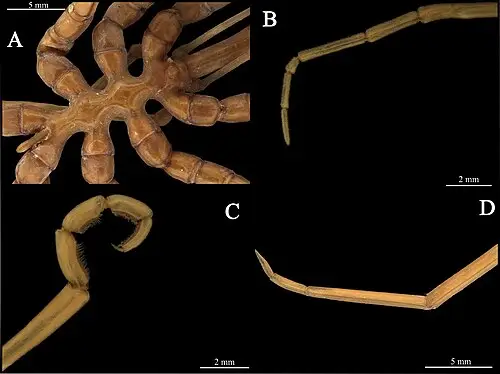
 📸 Photo
Photo: Lucena RA, Christoffersen ML (2022) · CC BY 4.0 · Wikimedia Commons Source
Giant sea spider
Colossendeis megalonyx (Giant sea spider · Giant sea spider)
Not Evaluated (NE) on the IUCN Red List yet.
💡 Everyday Comparisons for Size, Mass & Speed
- 💡 The examined specimen's leg span of 125 mm is about 1.5 times the width of a credit card (85.6 mm) (Comparison).
- 💡 Its maximum habitat depth of 4,900 m is about 1.8 times the height of Baekdusan (about 2,744 m) (Comparison).
Reference standards: coach bus ~12 m, mid-size car ~4.9 m, compact car ~1 t, basketball hoop 3.05 m, credit card 8.56 cm.
📖 1. Overview
The giant sea spider is a large sea spider widely distributed all around the Southern Ocean, with a tiny trunk but very long legs. Because it is hypothesized that several cryptic species may be mixed together, research is ongoing.
🦴 2. Anatomy & Morphology
A specimen examined from Victoria Land, Antarctica, had a trunk length of about 6.5 mm but a leg span of up to 125 mm. Its proboscis is a long, straight cylinder 1.8–1.9 times the trunk length.
🔍 3. Ecology & Behavior
It is a benthic species widely distributed across Antarctic and sub-Antarctic waters from depths of 3 m to 4,900 m, and is also found off South America, South Africa, and Madagascar. Encyclopedias note that it feeds on soft corals and small hydrozoans attached to sponges.
🇰🇷 4. Connection to Korea
No direct record connecting this species to Korea has been found.
📚 Sources & References
- • IUCN Red List: not evaluated (NE) — cross-checked with the Wikidata conservation-status entry
- • marinespecies.org — aphia.php
- • wikidata.org — Q2713800
- • commons.wikimedia.org — File:Colossendeis megalonyx (10.3897-zse.98.83671) Figure 3.
- • sealifebase.se — Colossendeis-megalonyx.html
- • vliz.be — 131952.pdf
- • ncbi.nlm.nih.gov — PMC4632570
- • encyclopedia.com — pycnogonida-sea-spiders
- • Silhouette: PhyloPic — Kurtis Wothe and Giovanna Sainz · CC0 1.0 (Congeneric silhouette — Colossendeis)
Recorded dimensions are widely cited representative estimates from public literature and may vary by study or specimen.