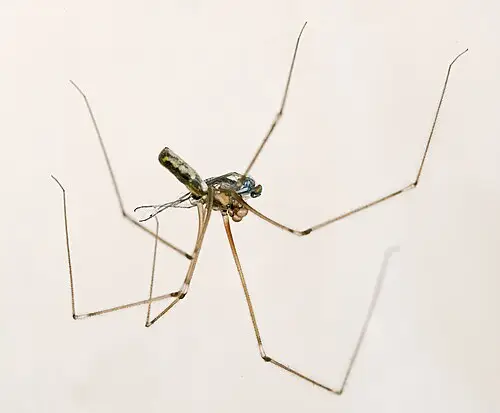
 📸 Photo
Photo: Didier Descouens · CC BY-SA 4.0 · Wikimedia Commons Source
Long-bodied cellar spider
Pholcus phalangioides (Long-bodied cellar spider · Long-bodied cellar spider)
Not Evaluated (NE) on the IUCN Red List yet.
💡 Everyday Comparisons for Size, Mass & Speed
- 💡 A body length of 8 mm is less than half the diameter of a Korean 10-won coin (18 mm) (Comparison).
- 💡 As a typical spider living on household ceilings and in corners, it helps reduce pest populations (Animal Diversity Web).
Reference standards: coach bus ~12 m, mid-size car ~4.9 m, compact car ~1 t, basketball hoop 3.05 m, credit card 8.56 cm.
📖 1. Overview
The long-bodied cellar spider is a long-legged spider that hangs upside down on ceilings and in corners of homes, preying on other spiders and small insects.
🦴 2. Anatomy & Morphology
Its body is pale yellowish brown with a large gray patch in the center of the cephalothorax, and both its body and legs are nearly translucent. Under a microscope, blood cells can be seen moving inside the legs and body of a living individual.
🔍 3. Ecology & Behavior
It spins a large, loose, flat horizontal web and hangs upside down beneath it. It kills and eats other spiders and small insects with venom, and sometimes invades and takes over the webs of other spiders.
🇰🇷 4. Connection to Korea
It is listed as 'Jip-yu-ryeong-geo-mi' (Korean name) on the National List of Species of Korea.
📚 Sources & References
- • IUCN Red List: not evaluated (NE) — cross-checked with the Wikidata conservation-status entry
- • catalogueoflife.org — 4GL9C
- • 국가생물종목록(국립생물자원관) ktsn 120000044467 — https://species.nibr.go.kr/home/mainHome.do?cont_link=009&subMenu=009002&contCd=009002&ktsn=120000044467
- • wikidata.org — Q1164137
- • commons.wikimedia.org — File:Pholcus phalangioides MHNT male.jpg
- • animaldiversity.org — Pholcus phalangioides
- • Silhouette: PhyloPic — Sean McCann · CC0 1.0
Recorded dimensions are widely cited representative estimates from public literature and may vary by study or specimen.