 📸 Photo
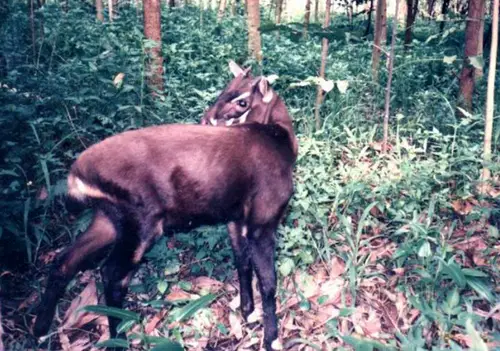
Photo: The original uploader was Silviculture at Vietnamese Wikipedia . · CC BY-SA 3.0 · Wikimedia Commons Source
Saola
Pseudoryx nghetinhensis (Saola · サオラ)
💡 Everyday Comparisons for Size, Mass & Speed
- 💡 The name "Saola" means spinning wheel posts in the local language, named after the shape of its horns (Animal Diversity Web).
- 💡 Its weight of 100 kg equals five 20 kg bags of rice (Comparison).
- 💡 In Vietnam and Laos, it has been hunted for its meat and hide (Animal Diversity Web).
Reference standards: coach bus ~12 m, mid-size car ~4.9 m, compact car ~1 t, basketball hoop 3.05 m, credit card 8.56 cm.
Site-computed relative index from recorded values; not a formal scientific metric.
📖 1. Overview
The Saola is a very rare bovid living in the wet forests of the Annamite Mountains along the border of Vietnam and Laos. It became known to science as a new species only relatively recently.
🦴 2. Anatomy & Morphology
Its body length is about 150 cm, with brown-toned fur, white markings on the sides of the neck, and a black stripe running from the shoulders to the lower back. Both sexes have horns, and its name means "spinning wheel posts."
🔍 3. Ecology & Behavior
It is a herbivore that feeds mainly on ferns and flowering plants. It appears to live alone and marks its territory by snapping saplings with its horns.
🇰🇷 4. Connection to Korea
No direct record connecting this species to Korea has been found.
📚 Sources & References
- • IUCN Red List CR (2020) — https://www.iucnredlist.org/species/18597/166485696
- • IUCN Red List category CR — latest assessment at iucnredlist.org
- • mammaldiversity.org — 1006273
- • iucnredlist.org — 166485696
- • wikidata.org — Q218792
- • commons.wikimedia.org — File:Pseudoryx nghetinhensis.PNG
- • animaldiversity.org — Pseudoryx nghetinhensis
- • Silhouette: PhyloPic — [unknown] · Public Domain Mark 1.0 (Related taxon silhouette — Aepyceros melampus)
Recorded dimensions are widely cited representative estimates from public literature and may vary by study or specimen.