 📸 Photo
Photo: No machine-readable author provided. MikeMurphy assumed (based on copyright claims). · Public domain · Wikimedia Commons Source
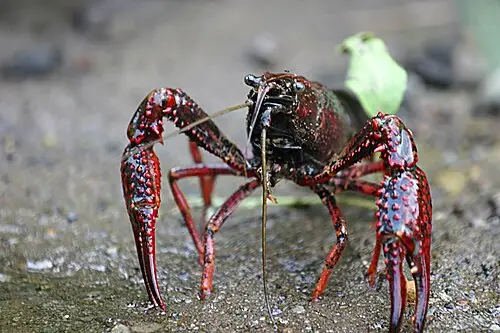
Red swamp crayfish
Procambarus clarkii (Red swamp crayfish · アメリカザリガニ)
💡 Everyday Comparisons for Size, Mass & Speed
- 💡 A maximum body length of 4.7 inches (about 12 cm) is slightly shorter than a ballpoint pen (about 14 cm) (Comparison).
- 💡 Animal Diversity Web explains that in Cajun communities of the United States this crayfish is a staple ingredient in everyday cooking, with over 48,500 ha of culture ponds in Louisiana alone. Introduced to Japan as food for American bullfrogs, it has now become a common household pet there.
Reference standards: coach bus ~12 m, mid-size car ~4.9 m, compact car ~1 t, basketball hoop 3.05 m, credit card 8.56 cm.
📖 1. Overview
The red swamp crayfish is a red crayfish native to North American swamps and ditches that has spread to many parts of the world for food and as a pet. The IUCN Red List assessed it as Least Concern (LC) in 2010.
🦴 2. Anatomy & Morphology
Its body is very dark red with a wedge-shaped black stripe on the abdomen. It has a pointed rostrum and movable eyes, and its first walking legs are modified into large, elongated pincers for catching prey. It grows by molting its exoskeleton.
🔍 3. Ecology & Behavior
It is a carnivore that preys on insect larvae, tadpoles, and snails, and also eats dead animals and worms when food is scarce. During droughts or cold weather it digs burrows to survive, and mates in late autumn.
🇰🇷 4. Connection to Korea
It is listed as 'Mi-guk-ga-jae' (Korean name) on the National List of Species of Korea.
📚 Sources & References
- • IUCN Red List LC (2010) — https://www.iucnredlist.org/species/153877/4557336
- • IUCN Red List category LC — latest assessment at iucnredlist.org
- • catalogueoflife.org — 7WLRT
- • iucnredlist.org — 4557336
- • 국가생물종목록(국립생물자원관) ktsn 120000520701 — https://species.nibr.go.kr/home/mainHome.do?cont_link=009&subMenu=009002&contCd=009002&ktsn=120000520701
- • wikidata.org — Q1133124
- • commons.wikimedia.org — File:Procambarus clarkii.jpg
- • animaldiversity.org — Procambarus clarkii
- • sealifebase.se — Procambarus-clarkii.html
- • species.nibr.go.kr — mainHome.do
- • Silhouette: PhyloPic — Mattia Menchetti · CC0 1.0
Recorded dimensions are widely cited representative estimates from public literature and may vary by study or specimen.