 📸 Photo
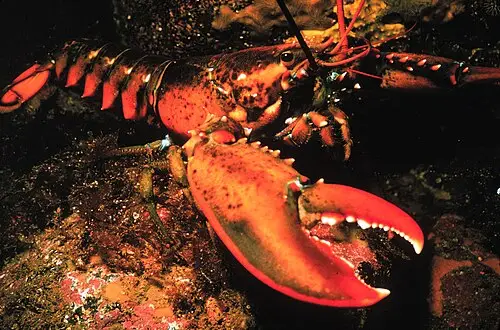
Photo: OAR/National Undersea Research Program (NURP). · Public domain · Wikimedia Commons Source
American lobster
Homarus americanus (American lobster · アメリカンロブスター)
💡 Everyday Comparisons for Size, Mass & Speed
- 💡 A commonly caught 25 cm lobster is slightly shorter than the long side of an A4 sheet of paper (about 29.7 cm), 0.5 kg is similar to a 500 mL carton of milk, and the maximum weight of 20 kg is similar to a 20 kg sack of rice (Comparison).
- 💡 According to Animal Diversity Web, the red color seen in restaurants comes from shell pigments released when boiled, and the white meat in the claws, legs, and tail muscle is prized as a delicacy. Picturing its blackish-green or brownish-green live body shows how different it looks in life versus on a plate.
Reference standards: coach bus ~12 m, mid-size car ~4.9 m, compact car ~1 t, basketball hoop 3.05 m, credit card 8.56 cm.
Site-computed relative index from recorded values; not a formal scientific metric.
📖 1. Overview
The American lobster is the largest lobster species, living on coastal sea floors of the northwestern Atlantic. The IUCN Red List assessed it as Least Concern (LC) in 2011.
🦴 2. Anatomy & Morphology
Its body consists of 21 segments (6 head, 8 thoracic, and 7 abdominal), and two of its 10 legs are large, powerful claws: one is a heavy crusher claw for pulverizing shells, and the other is a sharp ripper claw for tearing soft flesh. When alive, it is not red but blackish-green to brownish-green.
🔍 3. Ecology & Behavior
It hides in burrows or rock crevices during the day and comes out at night to eat clams, crabs, snails, small fish, and seaweeds; although mainly a scavenger feeding on dead animals, it also hunts live prey. Females can mate from about 5 years of age and carry their eggs under the tail for 10–11 months.
🇰🇷 4. Connection to Korea
No direct record connecting this species to Korea has been found.
📚 Sources & References
- • IUCN Red List LC (2011) — https://www.iucnredlist.org/species/170009/6705155
- • IUCN Red List category LC — latest assessment at iucnredlist.org
- • marinespecies.org — aphia.php
- • iucnredlist.org — 6705155
- • wikidata.org — Q37668
- • commons.wikimedia.org — File:Nur01521 - Flickr - NOAA Photo Library.jpg
- • animaldiversity.org — Homarus americanus
- • sealifebase.se — Homarus-americanus.html
- • fisheries.noaa.gov — american-lobster
- • Silhouette: PhyloPic — Andy Wilson · CC0 1.0
Recorded dimensions are widely cited representative estimates from public literature and may vary by study or specimen.