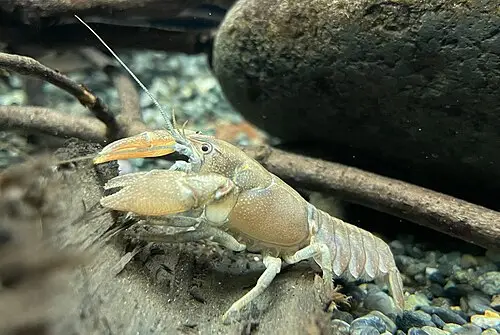
 📸 Photo
Photo: Totti · CC BY-SA 4.0 · Wikimedia Commons Source
Japanese crayfish
Cambaroides japonicus (Japanese crayfish · ニホンザリガニ)
💡 Everyday Comparisons for Size, Mass & Speed
- 💡 Its adult body length of 5–7 cm is slightly shorter than the long side of a credit card (about 8.6 cm) (Comparison).
- 💡 Information from Sapporo Maruyama Zoo notes that it was assessed as Vulnerable (VU, 2000) on the Japanese Ministry of the Environment Red List and designated a National Rare Species of Wild Fauna and Flora in January 2023. Because it has been confirmed to die from a water mold carried by the invasive crayfish Uchida-gajae (a Korean animal name), it is a representative case of native crayfish being threatened by the spread of invasive crayfish.
Reference standards: coach bus ~12 m, mid-size car ~4.9 m, compact car ~1 t, basketball hoop 3.05 m, credit card 8.56 cm.
📖 1. Overview
The Japanese crayfish is the only native crayfish endemic to Japan, living in cold, clear waters across all of Hokkaido and northern Aomori, Akita, and Iwate. The IUCN Red List assessed it as Data Deficient (DD) in 2010.
🦴 2. Anatomy & Morphology
Adults are 5–7 cm long and brown. Its claws and head lack spines, and the rostrum is a short triangle.
🔍 3. Ecology & Behavior
It is omnivorous, eating insects and organic matter centered on fallen leaves, and spends its whole life in freshwater without moving far. It takes 5 years to reach breeding age; it mates in autumn, lays 40–60 eggs in spring to carry under its abdomen, and hatches them in mid- to late June. Its lifespan is about 10 years.
🇰🇷 4. Connection to Korea
No direct record connecting this species to Korea has been found.
📚 Sources & References
- • IUCN Red List DD (2010) — https://www.iucnredlist.org/species/153751/4540770
- • IUCN Red List category DD — latest assessment at iucnredlist.org
- • catalogueoflife.org — 7RTV9
- • iucnredlist.org — 4540770
- • wikidata.org — Q13403251
- • commons.wikimedia.org — File:Cambaroides japonicus Yamano3.jpg
- • city.sapporo.jp — 099-j.html
Recorded dimensions are widely cited representative estimates from public literature and may vary by study or specimen.