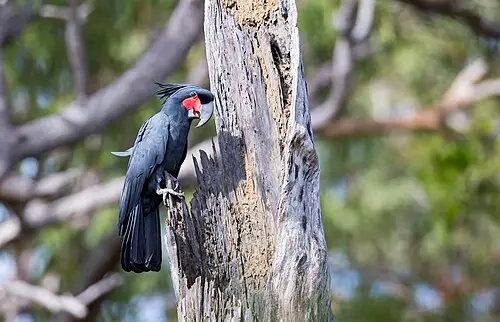
 📸 Photo
Photo: Jim Bendon from Karratha, Australia · CC BY-SA 2.0 · Wikimedia Commons Source
Palm Cockatoo
Probosciger aterrimus (Palm Cockatoo · ヤシオウム)
💡 Everyday Comparisons for Size, Mass & Speed
- 💡 Its weight of 1.1 kg is slightly heavier than a 1 L carton of milk, and its wingspan of 1 m is about three and a half sheets of A4 paper along the long side (Comparison).
- 💡 In the wild, it accepts food from people and raids bird feeders, and when food is scarce it may chew up house decks and siding.
Reference standards: coach bus ~12 m, mid-size car ~4.9 m, compact car ~1 t, basketball hoop 3.05 m, credit card 8.56 cm.
Site-computed relative index from recorded values; not a formal scientific metric.
📖 1. Overview
The Palm Cockatoo is a large, all-black cockatoo living in the rainforests of New Guinea and northern Australia. Its IUCN status is Near Threatened (NT).
🦴 2. Anatomy & Morphology
It is almost entirely black and can raise and lower a crest about 15 cm long on its crown. Because its bill never closes completely, its black-tipped red tongue is always slightly visible, and males have a larger bill.
🔍 3. Ecology & Behavior
It feeds mainly on leaf buds, seeds, and fruits, occasionally eating insects, and crushes hard seeds and nuts with its powerful bill. Pairs bond for life and breed from August to January; unable to excavate their own cavities, they nest in hollows of large trees such as palms.
🇰🇷 4. Connection to Korea
No direct record connecting this species to Korea has been found.
📚 Sources & References
- • IUCN Red List NT (2023) — https://www.iucnredlist.org/species/22684723/221314898
- • IUCN Red List category NT — latest assessment at iucnredlist.org
- • doi.org — avilist.v2026
- • iucnredlist.org — 221314898
- • wikidata.org — Q31501
- • commons.wikimedia.org — File:Probosciger aterrimus, Cape York 1.jpg
- • animaldiversity.org — Probosciger aterrimus
- • Silhouette: PhyloPic — author not recorded · Public Domain Mark 1.0
Recorded dimensions are widely cited representative estimates from public literature and may vary by study or specimen.