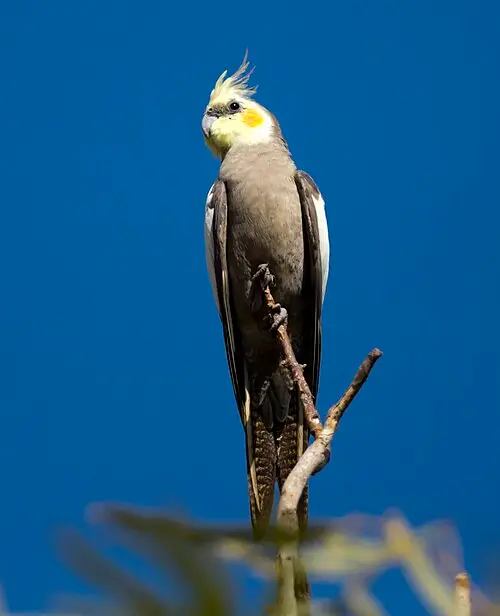
 📸 Photo
Photo: Jim Bendon · CC BY-SA 2.0 · Wikimedia Commons Source
Cockatiel
Nymphicus hollandicus (Cockatiel · オカメインコ)
💡 Everyday Comparisons for Size, Mass & Speed
- 💡 Its body length of 35 cm is about 5 cm longer than the long side of an A4 sheet of paper (29.7 cm), and its weight of 90 g is similar to one and a half chicken eggs (about 60 g) (Comparison).
- 💡 Selective breeding has produced dozens of color mutations (such as the all-white or pale yellow lutino), and breeders compete with their birds at society exhibitions, where some sell for high prices.
Reference standards: coach bus ~12 m, mid-size car ~4.9 m, compact car ~1 t, basketball hoop 3.05 m, credit card 8.56 cm.
Site-computed relative index from recorded values; not a formal scientific metric.
📖 1. Overview
The Cockatiel is a small crested parrot living in the open inland areas of Australia and is the second most popular pet bird after the Budgerigar.
🦴 2. Anatomy & Morphology
It is the smallest and slenderest of the cockatoos, and unusually for a crested parrot, its tail comes to a point. The tail is about 15 cm long, about half its body length, and spreads like a fan in flight to control altitude and balance.
🔍 3. Ecology & Behavior
Its long toes allow it to walk steadily on the ground, and it rotates dry seeds of grasses, shrubs, and trees with its tongue while husking them with its bill. Once paired, mates stay together all year round, moving in pairs or flocks of hundreds, and are especially fond of Acacia seeds.
🇰🇷 4. Connection to Korea
No direct record connecting this species to Korea has been found.
📚 Sources & References
- • IUCN Red List LC (2018) — https://www.iucnredlist.org/species/22684828/132056250
- • IUCN Red List category LC — latest assessment at iucnredlist.org
- • doi.org — avilist.v2026
- • iucnredlist.org — 132056250
- • wikidata.org — Q514809
- • commons.wikimedia.org — File:Cockateil.jpg
- • animaldiversity.org — Nymphicus hollandicus
- • Silhouette: PhyloPic — Matias · CC0 1.0
Recorded dimensions are widely cited representative estimates from public literature and may vary by study or specimen.