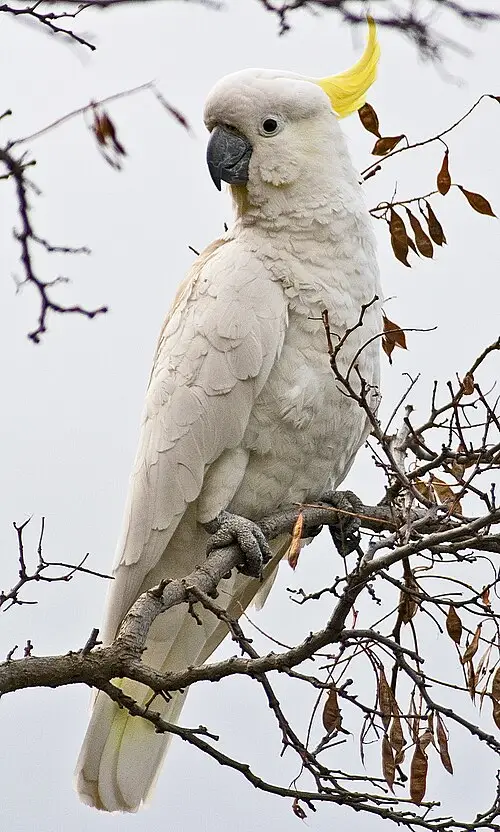
 📸 Photo
Photo: JJ Harrison ( https://www.jjharrison.com.au/ ) · CC BY-SA 3.0 · Wikimedia Commons Source
Sulphur-crested Cockatoo
Cacatua galerita (Sulphur-crested Cockatoo · キバタン)
💡 Everyday Comparisons for Size, Mass & Speed
- 💡 It can be seen in suburban Australian parks and gardens, where it sometimes pecks and damages house timber and garden trees (ADW).
- 💡 When large flocks gather in grain fields it is regarded as a pest, but because it is protected under Australian federal law, a government permit is required to control it (ADW).
- 💡 Its average mass of 800 g is slightly more than half of a 1.5 L bottle of water (Comparison).
Reference standards: coach bus ~12 m, mid-size car ~4.9 m, compact car ~1 t, basketball hoop 3.05 m, credit card 8.56 cm.
Site-computed relative index from recorded values; not a formal scientific metric.
📖 1. Overview
The sulphur-crested cockatoo is a large white parrot about 50 cm long that can raise or fold the yellow crest on its head. It lives in a wide range of habitats from forests and savannas to suburban parks and gardens.
🦴 2. Anatomy & Morphology
Its body is white with a sulfur-yellow crest on top of the head and pale yellow undersides to the wings and tail. Males and females look similar, but up close a female's eyes are reddish-brown while a male's are darker brown.
🔍 3. Ecology & Behavior
In the wild, it feeds on the ground and in trees on seeds, nuts, fruits, and flowers, as well as insects and larvae. It also damages newly planted grain fields and ripening crops.
🇰🇷 4. Connection to Korea
No direct record connecting this species to Korea has been found.
📚 Sources & References
- • IUCN Red List LC (2018) — https://www.iucnredlist.org/species/22684781/131914971
- • IUCN Red List category LC — latest assessment at iucnredlist.org
- • doi.org — avilist.v2026
- • iucnredlist.org — 131914971
- • wikidata.org — Q207107
- • commons.wikimedia.org — File:Cacatua galerita Tas 2.jpg
- • animaldiversity.org — Cacatua galerita
- • Silhouette: PhyloPic — Ferran Sayol · CC0 1.0 (Congeneric silhouette — Cacatua sulphurea)
Recorded dimensions are widely cited representative estimates from public literature and may vary by study or specimen.