 📸 Photo
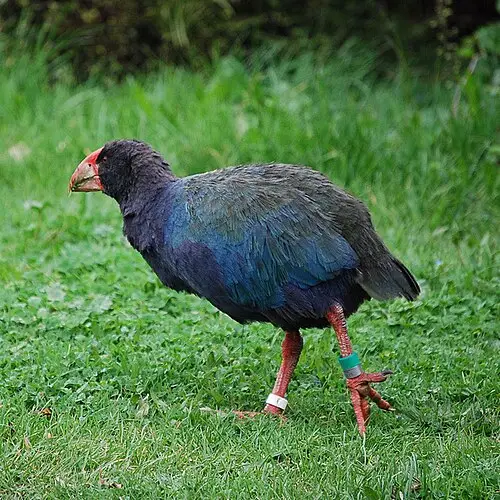
Photo: Porphyrio_hochstetteri_-Tiritiri_Matangi_Island-8b.jpg : Ashleigh Thompson derivative work: Snowmanradio ( talk ) · CC BY 2.0 · Wikimedia Commons Source
South Island Takahe
Porphyrio hochstetteri (South Island Takahe · タカヘ)
💡 Everyday Comparisons for Size, Mass & Speed
- 💡 The average male weight of 2.7 kg is slightly lighter than a 3 kg bag of rice (Comparison).
- 💡 Because it is rare and distinctive, it supports birdwatching tourism to view populations introduced onto offshore islands (Animal Diversity Web).
- 💡 As a classic example of an island bird that lost flight, it serves as a subject for research on flightless rails (Animal Diversity Web).
Reference standards: coach bus ~12 m, mid-size car ~4.9 m, compact car ~1 t, basketball hoop 3.05 m, credit card 8.56 cm.
Site-computed relative index from recorded values; not a formal scientific metric.
📖 1. Overview
The South Island Takahe is a large, flightless rail endemic to New Zealand, with bluish plumage and a large red bill and legs.
🦴 2. Anatomy & Morphology
Its head, breast, and neck are deep blue, and its wings and back are a mix of olive and blue. It has large, strong red legs, a red bill, and a red frontal shield.
🔍 3. Ecology & Behavior
It feeds mainly on the leaf bases and seeds of alpine tussock grasses and occasionally eats insects. It lays 1–3 eggs per clutch and incubates them for about 30 days, though on average only one chick survives to adulthood.
🇰🇷 4. Connection to Korea
No direct record connecting this species to Korea has been found.
📚 Sources & References
- • IUCN Red List EN (2020) — https://www.iucnredlist.org/species/22692808/170983662
- • IUCN Red List category EN — latest assessment at iucnredlist.org
- • doi.org — avilist.v2026
- • iucnredlist.org — 170983662
- • wikidata.org — Q212302
- • commons.wikimedia.org — File:Porphyrio hochstetteri -Tiritiri Matangi Island-8b-3c.j
- • animaldiversity.org — Porphyrio hochstetteri
- • Silhouette: PhyloPic — Michael Day · CC0 1.0 (Related taxon silhouette — Crex crex)
Recorded dimensions are widely cited representative estimates from public literature and may vary by study or specimen.