 📸 Photo
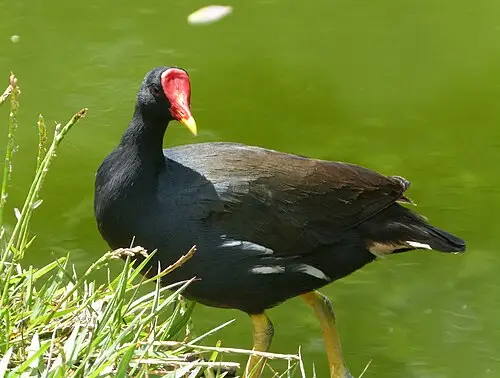
Photo: gailhampshire from Cradley, Malvern, U.K · CC BY 2.0 · Wikimedia Commons Source
Common Moorhen
Gallinula chloropus (Common Moorhen · バン)
💡 Everyday Comparisons for Size, Mass & Speed
- 💡 Its maximum weight of about 0.5 kg is similar to a 500 mL bottle of water (Comparison).
- 💡 In reed beds along the edges of reservoirs and ponds, it can be spotted by its red frontal shield and flicking tail (National List of Species of Korea).
- 💡 Animal Diversity Web classifies this bird as also living along urban and suburban watersides.
Reference standards: coach bus ~12 m, mid-size car ~4.9 m, compact car ~1 t, basketball hoop 3.05 m, credit card 8.56 cm.
Site-computed relative index from recorded values; not a formal scientific metric.
📖 1. Overview
The Common Moorhen is a black waterbird notable for the red shield on its forehead. It is widely distributed across temperate and tropical regions except Australia and New Zealand.
🦴 2. Anatomy & Morphology
Its body is black overall, its bill is bright red, and its legs are yellowish-green. Its shoulders, back, and wing feathers are dark brown.
🔍 3. Ecology & Behavior
It is an omnivore that eats a variety of foods including fruits, insects, mollusks, and crustaceans. From May to August it lays 6–9 eggs per clutch, and it walks quietly among reeds and cattails while flicking its tail up and down.
🇰🇷 4. Connection to Korea
In Korea, it is a common summer visitor breeding in wetlands and reservoirs nationwide in summer, with small numbers remaining through the winter.
📚 Sources & References
- • IUCN Red List LC (2025) — https://www.iucnredlist.org/species/62120190/281847787
- • IUCN Red List category LC — latest assessment at iucnredlist.org
- • doi.org — avilist.v2026
- • iucnredlist.org — 281847787
- • 국가생물종목록(국립생물자원관) ktsn 120000001641 — https://species.nibr.go.kr/home/mainHome.do?cont_link=009&subMenu=009002&contCd=009002&ktsn=120000001641
- • wikidata.org — Q18847
- • commons.wikimedia.org — File:Common Moorhen (Gallinula chloropus pyrrhorrhoa), Mauri
- • animaldiversity.org — Gallinula chloropus
- • species.nibr.go.kr — mainHome.do
- • Silhouette: PhyloPic — Andy Wilson · CC0 1.0
Recorded dimensions are widely cited representative estimates from public literature and may vary by study or specimen.