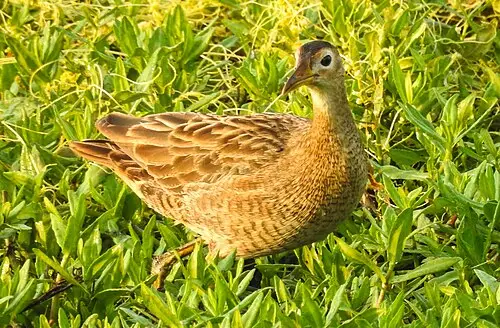
 📸 Photo
Photo: Sahana M · CC BY-SA 4.0 · Wikimedia Commons Source
Watercock
Gallicrex cinerea (Watercock · ツルクイナ)
🇰🇷 Class II endangered wildlife (Korea) · Natural Monument (Korea) «Watercock»
💡 Everyday Comparisons for Size, Mass & Speed
- 💡 The male's body length of about 43 cm is roughly 1.4 times the long side of an A4 sheet of paper (29.7 cm) (Comparison).
- 💡 The female's length of 31–36 cm is similar to or slightly longer than the long side of an A4 sheet of paper (Comparison).
Reference standards: coach bus ~12 m, mid-size car ~4.9 m, compact car ~1 t, basketball hoop 3.05 m, credit card 8.56 cm.
📖 1. Overview
The Watercock is a bird in the rail family distributed from India through Southeast Asia, China, the Korean Peninsula, and the Ussuri region, living in grassy freshwater wetlands. It is listed as Least Concern (LC) by the IUCN, though its population is declining.
🦴 2. Anatomy & Morphology
Males measure 41–43 cm and females 31–36 cm, making males larger. Breeding males have a dark grayish-black body, a bright yellow bill, and bright red legs.
🔍 3. Ecology & Behavior
It has been recorded plucking seed heads of grasses such as reeds and barnyard grass. Birds that breed in the north migrate south for the winter.
🇰🇷 4. Connection to Korea
In Korea, it is a Class II endangered wildlife species (Korea) and was designated as a Natural Monument (Korea) on March 17, 2005. The Hong Kong Bird Watching Society notes that its range includes the Korean Peninsula.
📚 Sources & References
- • IUCN Red List LC (2025) — https://www.iucnredlist.org/species/22692789/280922702
- • 멸종위기 야생생물 Ⅱ급 · 천연기념물 «뜸부기» — 국가생물종목록(국립생물자원관) ktsn 120000001639 — https://species.nibr.go.kr/home/mainHome.do?cont_link=009&subMenu=009002&contCd=009002&ktsn=120000001639
- • IUCN Red List category LC — latest assessment at iucnredlist.org
- • Korean protection status: Class II endangered wildlife (Korea) · Natural Monument (Korea) «Watercock»
- • doi.org — avilist.v2026
- • iucnredlist.org — 280922702
- • 국가생물종목록(국립생물자원관) ktsn 120000001639 — https://species.nibr.go.kr/home/mainHome.do?cont_link=009&subMenu=009002&contCd=009002&ktsn=120000001639
- • heritage.go.kr — culSelectDetail.do
- • wikidata.org — Q494424
- • commons.wikimedia.org — File:Watercock (Gallicrex cinerea).jpg
- • avifauna.hkbws.org.hk — 008600
- • nparks.gov.sg — 538
- • Silhouette: PhyloPic — Michael Day · CC0 1.0 (Related taxon silhouette — Crex crex)
Recorded dimensions are widely cited representative estimates from public literature and may vary by study or specimen.