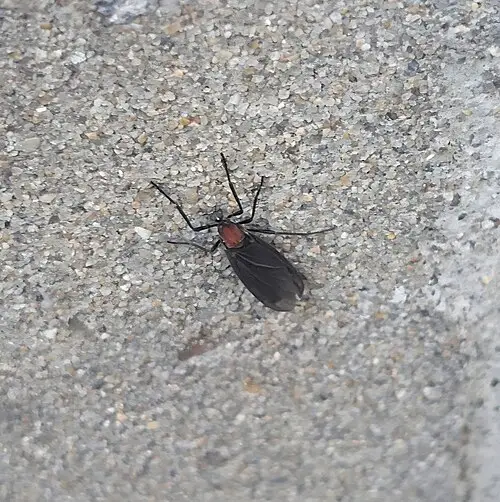
 📸 Photo
Photo: Inju Ahn · CC BY 4.0 · Wikimedia Commons Source
Lovebug
Plecia longiforceps (Lovebug · ヒイロトゲナシケバエ)
Not Evaluated (NE) on the IUCN Red List yet.
💡 Everyday Comparisons for Size, Mass & Speed
- 💡 Mass outbreaks in residential areas caused discomfort and revulsion among residents, and the National Institute of Biological Resources (NIBR) monitors its distribution through citizen science programs (National List of Species of Korea).
- 💡 Adults sip nectar from flowers and fly in swarms in open spaces between forests, where spiders and birds act as natural predators (National List of Species of Korea).
Reference standards: coach bus ~12 m, mid-size car ~4.9 m, compact car ~1 t, basketball hoop 3.05 m, credit card 8.56 cm.
📖 1. Overview
The lovebug is a march fly (family Bibionidae) that has occurred in mass outbreaks in Seoul and the surrounding capital region since 2022, causing inconvenience to residents.
🦴 2. Anatomy & Morphology
Official sources do not provide body size or appearance descriptions. Larvae live in humus soil in groups of dozens to hundreds.
🔍 3. Ecology & Behavior
In Korea, adults appear from late June to early July, overwinter as larvae, and pupate in June. Adults fly in swarms in open spaces, and after mating, a single female lays 300–500 eggs on the soil surface.
🇰🇷 4. Connection to Korea
According to the National List of Species of Korea, mass outbreaks have occurred in parts of the Seoul metropolitan area since 2022.
📚 Sources & References
- • IUCN Red List: not evaluated (NE) — cross-checked with the Wikidata conservation-status entry
- • catalogueoflife.org — 4K2L3
- • 국가생물종목록(국립생물자원관) ktsn 120000517046 — https://species.nibr.go.kr/home/mainHome.do?cont_link=009&subMenu=009002&contCd=009002&ktsn=120000517046
- • wikidata.org — Q14675522
- • commons.wikimedia.org — File:Plecia longiforceps.jpg
- • species.nibr.go.kr — mainHome.do
- • Silhouette: PhyloPic — Caleb M. Gordon · CC0 1.0 (Congeneric silhouette — Plecia nearctica)
Recorded dimensions are widely cited representative estimates from public literature and may vary by study or specimen.