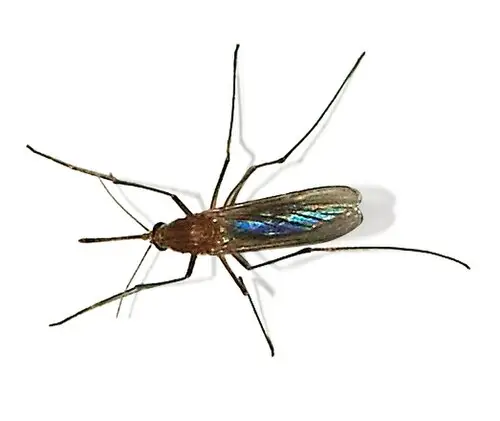
 📸 Photo
Photo: Alvesgaspar · CC BY-SA 3.0 · Wikimedia Commons Source
Northern house mosquito
Culex pipiens (Northern house mosquito · アカイエカ)
Not Evaluated (NE) on the IUCN Red List yet.
💡 Everyday Comparisons for Size, Mass & Speed
- 💡 Its body length of 4–10 mm is about the length of one to two grains of rice (about 5 mm) (Comparison).
- 💡 Places where water collects around the home—such as empty flowerpot saucers, bird water dishes, and storm drains—serve as breeding grounds for this mosquito.
- 💡 The Korea Disease Control and Prevention Agency explains that standing water in septic tanks or artificial containers becomes a breeding site for mosquitoes capable of transmitting Japanese encephalitis.
Reference standards: coach bus ~12 m, mid-size car ~4.9 m, compact car ~1 t, basketball hoop 3.05 m, credit card 8.56 cm.
📖 1. Overview
The northern house mosquito is a mosquito widespread across temperate regions that in Korea breeds mainly in small pools of standing water in urban areas. In 2026, Japanese encephalitis virus genes were detected in this mosquito, prompting a nationwide alert.
🦴 2. Anatomy & Morphology
It is a medium-sized mosquito 4–10 mm long, brown overall without any conspicuous markings. Males are slightly smaller than females and have feathery antennae.
🔍 3. Ecology & Behavior
Females suck blood from vertebrates such as humans and birds to obtain protein and iron for egg production, while both sexes ordinarily feed on sugars such as nectar. It lays eggs in murky standing water such as ditches, large puddles, flowerpot saucers, and storm drains.
🇰🇷 4. Connection to Korea
The Korea Disease Control and Prevention Agency explains that the northern house mosquito lives mainly in small urban bodies of standing water rich in organic matter (such as septic tanks and artificial containers). In June 2026, Japanese encephalitis virus genes were detected in this mosquito collected in Daegu, leading to a Japanese encephalitis alert.
📚 Sources & References
- • IUCN Red List: not evaluated (NE) — cross-checked with the Wikidata conservation-status entry
- • catalogueoflife.org — 32BNW
- • 국가생물종목록(국립생물자원관) ktsn 120000021846 — https://species.nibr.go.kr/home/mainHome.do?cont_link=009&subMenu=009002&contCd=009002&ktsn=120000021846
- • wikidata.org — Q27958
- • commons.wikimedia.org — File:Culex pipiens 2007-1.jpg
- • ecdc.europa.eu — culex-pipiens
- • ohioline.osu.edu — ent-89
- • kdca.go.kr — artclView.do
- • Silhouette: PhyloPic — author not recorded · Public Domain Mark 1.0 (Congeneric silhouette — Culex)
Recorded dimensions are widely cited representative estimates from public literature and may vary by study or specimen.