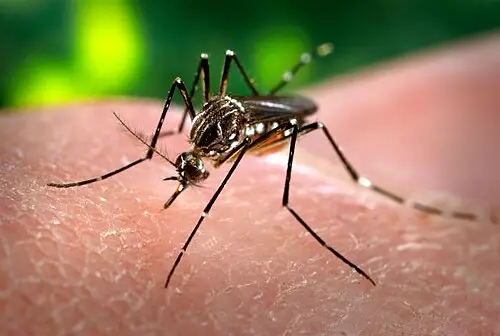
 📸 Photo
Photo: James Gathany · Public domain · Wikimedia Commons Source
Yellow fever mosquito
Aedes aegypti (Yellow fever mosquito · ネッタイシマカ)
Not Evaluated (NE) on the IUCN Red List yet.
💡 Everyday Comparisons for Size, Mass & Speed
- 💡 Its size of about 1/4 inch (6–7 mm) is about one-third the diameter of a Korean 10-won coin (18 mm) (Comparison).
- 💡 It breeds in standing water in unused flowerpots, old tires, unmaintained swimming pools, and drains, and in areas without piped water it develops in stored water (University of Florida UF/IFAS).
Reference standards: coach bus ~12 m, mid-size car ~4.9 m, compact car ~1 t, basketball hoop 3.05 m, credit card 8.56 cm.
📖 1. Overview
The yellow fever mosquito is a major mosquito vector of yellow fever that originated in Africa and is now widely spread across tropical and subtropical regions.
🦴 2. Anatomy & Morphology
White scales on the top of its thorax form a lyre shape, and there is a white band on each tarsal segment of the hind legs. The abdomen is mostly dark brown to black with a pointed tip, and females are larger than males.
🔍 3. Ecology & Behavior
Both males and females feed on plant nectar, but females are active during the day and feed mainly on human blood to produce eggs. A female lays 100–200 eggs at a time, and the eggs can survive dry conditions for months, aiding their wide dispersal.
🇰🇷 4. Connection to Korea
No direct record connecting this species to Korea has been found.
📚 Sources & References
- • IUCN Red List: not evaluated (NE) — cross-checked with the Wikidata conservation-status entry
- • catalogueoflife.org — 89W72
- • wikidata.org — Q1148004
- • commons.wikimedia.org — File:Aedes aegypti CDC-Gathany.jpg
- • ask.ifas.ufl.edu — IN792
- • Silhouette: PhyloPic — Jaramillo Hector Sergio · Public Domain Mark 1.0
Recorded dimensions are widely cited representative estimates from public literature and may vary by study or specimen.