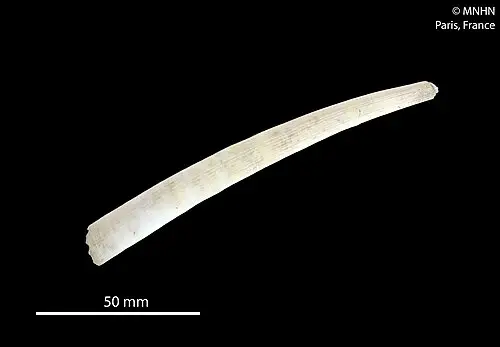
 📸 Photo
Photo: Marie Hennion · CC BY 4.0 · Wikimedia Commons Source
Vernede's tusk
Pictodentalium vernedei (Vernede's tusk · Vernede's tusk)
Not Evaluated (NE) on the IUCN Red List yet.
💡 Everyday Comparisons for Size, Mass & Speed
- 💡 Its shell shape is described as resembling an elephant's ivory tusk (Comparison, tusk shell description).
- 💡 A study that sequenced the complete mitochondrial genome from a specimen collected in the East China Sea in March 2020 was published in 2023 (Genes 14(1):210).
Reference standards: coach bus ~12 m, mid-size car ~4.9 m, compact car ~1 t, basketball hoop 3.05 m, credit card 8.56 cm.
📖 1. Overview
Vernede's tusk is a tusk shell with an ivory-like shell, living on the sea floor off the coasts of China and Japan.
🦴 2. Anatomy & Morphology
Tusk shells are described as having a tusk-shaped shell that is open at both the front and rear ends.
🔍 3. Ecology & Behavior
It lives on the bottom at depths of 20–128 m. Tusk shells are known to live buried in sand or mud and prey mainly on foraminifera.
🇰🇷 4. Connection to Korea
It is listed on the National List of Species of Korea under the name Soeppul-jogae (Korean name).
📚 Sources & References
- • IUCN Red List: not evaluated (NE) — cross-checked with the Wikidata conservation-status entry
- • marinespecies.org — aphia.php
- • 국가생물종목록(국립생물자원관) ktsn 120000216900 — https://species.nibr.go.kr/home/mainHome.do?cont_link=009&subMenu=009002&contCd=009002&ktsn=120000216900
- • wikidata.org — Q3802981
- • commons.wikimedia.org — File:Pictodentalium vernedei (MNHN-IM-2012-38340) 001.jpeg
- • sealifebase.se — Pictodentalium-vernedei.html
- • pmc.ncbi.nlm.nih.gov — PMC9859601
- • Silhouette: PhyloPic — author not recorded · CC0 1.0 (Related taxon silhouette — Dentalium dentalis)
Recorded dimensions are widely cited representative estimates from public literature and may vary by study or specimen.