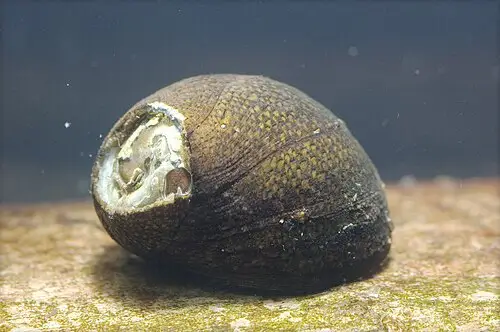
 📸 Photo
Photo: Seotaro · CC BY-SA 3.0 · Wikimedia Commons Source
Clithon retropictum
Clithon retropictum (Clithon retropictum · Clithon retropictum)
Not Evaluated (NE) on the IUCN Red List yet.
🇰🇷 Class II endangered wildlife (Korea)
💡 Everyday Comparisons for Size, Mass & Speed
- 💡 Development in everyday life—such as road and bridge construction and water pollution—that alters estuarine habitats is its main threat (National Institute of Ecology).
- 💡 A shell height of 1.5 cm is slightly more than half the diameter of a Korean 500-won coin (about 2.65 cm) (Comparison).
Reference standards: coach bus ~12 m, mid-size car ~4.9 m, compact car ~1 t, basketball hoop 3.05 m, credit card 8.56 cm.
📖 1. Overview
Clithon retropictum is a small snail living on stream bottoms in brackish zones where seawater and freshwater mix.
🦴 2. Anatomy & Morphology
Its shell has triangular yellow and black spots on a greenish-brown background, with 2–3 yellowish-brown bands on the body whorl. The operculum is calcareous with a yellow line along the margin.
🔍 3. Ecology & Behavior
It crawls over submerged stones, grazing on attached algae and organic matter. Its lifespan is known to be about 12 years, and in summer it lays white egg capsules on stones that hatch around September.
🇰🇷 4. Connection to Korea
Designated as Class II endangered wildlife (Korea), it is distributed in Gangwon-do, Gyeongsangbuk-do, Gyeongsangnam-do, Jeollanam-do, and Jeju Island, and has recently been confirmed in brackish areas along the East Sea coast as well. Road and bridge construction, water pollution, and salinity changes are major threats.
📚 Sources & References
- • 멸종위기 야생생물 Ⅱ급 — 국가생물종목록(국립생물자원관) ktsn 120000226312 — https://species.nibr.go.kr/home/mainHome.do?cont_link=009&subMenu=009002&contCd=009002&ktsn=120000226312
- • IUCN Red List: not evaluated (NE) — cross-checked with the Wikidata conservation-status entry
- • Korean protection status: Class II endangered wildlife (Korea)
- • catalogueoflife.org — 5YYZG
- • 국가생물종목록(국립생물자원관) ktsn 120000226312 — https://species.nibr.go.kr/home/mainHome.do?cont_link=009&subMenu=009002&contCd=009002&ktsn=120000226312
- • wikidata.org — Q61685667
- • commons.wikimedia.org — File:Clithon retropictus(Hamamatsu,Shizuoka,Japan,2007).jpg
- • nie.re.kr — view.do
Recorded dimensions are widely cited representative estimates from public literature and may vary by study or specimen.