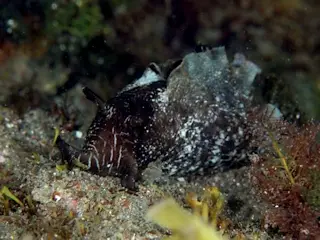
 📸 Photo
Photo: Izuzuki Diver · CC BY-SA 2.5 · Wikimedia Commons Source
Aplysia kurodai
Aplysia kurodai (Aplysia kurodai · Aplysia kurodai)
Not Evaluated (NE) on the IUCN Red List yet.
💡 Everyday Comparisons for Size, Mass & Speed
- 💡 Its maximum length of 40 cm is about one and a half 30 cm rulers (Comparison).
- 💡 Its maximum weight of 590 g is slightly heavier than a 500 mL bottle of water (Comparison).
- 💡 It can be seen along the shores of Gangwon-do, Gyeongsangbuk-do, and Jeju Island (National List of Species of Korea).
Reference standards: coach bus ~12 m, mid-size car ~4.9 m, compact car ~1 t, basketball hoop 3.05 m, credit card 8.56 cm.
Site-computed relative index from recorded values; not a formal scientific metric.
📖 1. Overview
Aplysia kurodai is a large sea hare that feeds on seaweeds and releases purple ink when disturbed. It lives along the East Sea coast, South Sea coast, and Jeju Island coasts of Korea.
🦴 2. Anatomy & Morphology
Its body has countless large and small white spots scattered over a blackish-brown ground. Inside the body is a thin, convex lens-shaped shell, and when stimulated it secretes purple fluid from a gland on the lower right side of the mantle.
🔍 3. Ecology & Behavior
It is an herbivore that grazes on seaweeds and grows very rapidly, more than doubling its weight in a single month when the water is warm. It is a hermaphrodite with a lifespan of about 1 year.
🇰🇷 4. Connection to Korea
It is listed as 'Gunso' (Korean name) in the National List of Species of Korea and inhabits the coasts of Gangwon-do, Gyeongsangbuk-do, and Jeju Island.
📚 Sources & References
- • IUCN Red List: not evaluated (NE) — cross-checked with the Wikidata conservation-status entry
- • marinespecies.org — aphia.php
- • 국가생물종목록(국립생물자원관) ktsn 120000133005 — https://species.nibr.go.kr/home/mainHome.do?cont_link=009&subMenu=009002&contCd=009002&ktsn=120000133005
- • wikidata.org — Q13386101
- • commons.wikimedia.org — File:Aplysia kurodai.jpg
- • species.nibr.go.kr — mainHome.do
- • sealifebase.se — Aplysia-kurodai.html
- • Silhouette: PhyloPic — Marina Vingiani · CC BY 4.0 (Congeneric silhouette — Aplysina sp.)
Recorded dimensions are widely cited representative estimates from public literature and may vary by study or specimen.