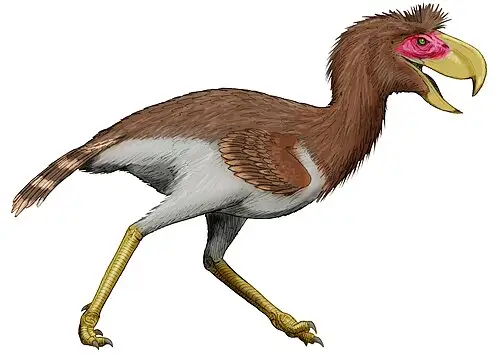
 🎨 Restoration
Restoration: ДиБгд · CC BY 4.0 · Wikimedia Commons Source
Life restorations are artistic reconstructions based on fossil evidence; true coloration and soft-tissue details remain uncertain.
Phorusrhacos
Phorusrhacos longissimus (Phorusrhacos · Phorusrhacos)
Known only from fossils. The IUCN Red List assesses only species extant since 1500 CE, so fossil taxa are not assigned a category.
💡 Everyday Comparisons for Size, Mass & Speed
- 💡 A weight of 100 kg is equal to five 20 kg bags of rice (Comparison).
- 💡 Across the group as a whole, height reached up to 280 cm, too tall to fit comfortably inside a room with a typical ceiling of around 2.4 m (Comparison).
Reference standards: coach bus ~12 m, mid-size car ~4.9 m, compact car ~1 t, basketball hoop 3.05 m, credit card 8.56 cm.
Site-computed relative index from recorded values; not a formal scientific metric.
📖 1. Overview
Phorusrhacos longissimus (genus Phorusrhacos) was a giant flightless predatory bird in the family Phorusrhacidae, commonly called 'terror birds.' This group was the top predator dominating South America through most of the Cenozoic.
🦴 2. Anatomy & Morphology
It was a large, flightless carnivorous bird, and this species is estimated to have weighed over 100 kg. Across the family Phorusrhacidae as a whole, height ranged from 80 cm to 280 cm.
🔍 3. Fossil Record & Paleoecology
Phorusrhacids stood at the top of the ecosystem in South America for at least 40 million years, and bone-histology studies of two species in the group indicate continuous rapid growth and bones suited for a running lifestyle.
🇰🇷 4. Connection to Korea
No direct record connecting this species to Korea has been found.
📚 Sources & References
- • Fossil taxon — the IUCN Red List assesses only species living or extinct since 1500
- • paleobiodb.org — basicTaxonInfo
- • wikidata.org — Q84705422
- • commons.wikimedia.org — File:PhorusrhacosLongissimus-Skull-BackgroundKnockedOut-ROM-
- • ebi.ac.uk — fullTextXML
- • Silhouette: PhyloPic — Thomas W. LaBarge · CC BY 4.0
Recorded dimensions are widely cited representative estimates from public literature and may vary by study or specimen.