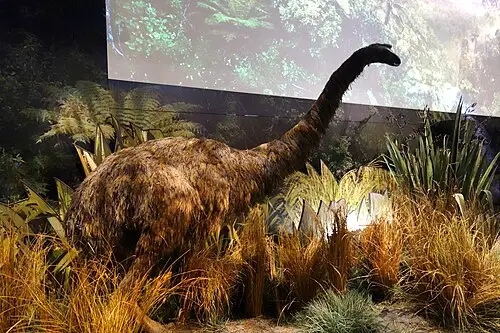
 🎨 Restoration
Restoration: Daderot · CC0 · Wikimedia Commons Source
Life restorations are artistic reconstructions based on fossil evidence; true coloration and soft-tissue details remain uncertain.
Dinornis
Dinornis novaezealandiae (Dinornis · ジャイアントモア)
Known only from fossils. The IUCN Red List assesses only species extant since 1500 CE, so fossil taxa are not assigned a category.
💡 Everyday Comparisons for Size, Mass & Speed
- 💡 Its height of about 3 m with the neck extended is nearly the same as the height of a basketball hoop (3.05 m) (Comparison).
- 💡 A maximum female weight of 242 kg is more than the weight of 3 adult men (about 70 kg each) (Comparison).
Reference standards: coach bus ~12 m, mid-size car ~4.9 m, compact car ~1 t, basketball hoop 3.05 m, credit card 8.56 cm.
Site-computed relative index from recorded values; not a formal scientific metric.
📖 1. Overview
Dinornis novaezealandiae (the North Island giant moa) was a giant flightless bird that lived on the North Island of New Zealand and was the second-largest species of moa. Overhunting by humans was the main cause of its extinction.
🦴 2. Anatomy & Morphology
Its back height reached up to about 2 m, or about 3 m with its neck extended, and its body was covered in hair-like feathers up to 18 cm long. Females were much larger than males, showing one of the greatest size differences between sexes among birds.
🔍 3. Fossil Record & Paleoecology
Judging from the shape of its beak and the large amount of stones in its gizzard, it likely fed on fibrous food such as twigs and leaves. It also ate flowers, fruits, and seeds, and ate very little grass.
🇰🇷 4. Connection to Korea
No direct record connecting this species to Korea has been found.
📚 Sources & References
- • Fossil taxon — the IUCN Red List assesses only species living or extinct since 1500
- • paleobiodb.org — basicTaxonInfo
- • wikidata.org — Q4691773
- • nzbirdsonline.org.nz — north-island-giant-moa
- • Silhouette: PhyloPic — Steven Traver · CC0 1.0
Recorded dimensions are widely cited representative estimates from public literature and may vary by study or specimen.