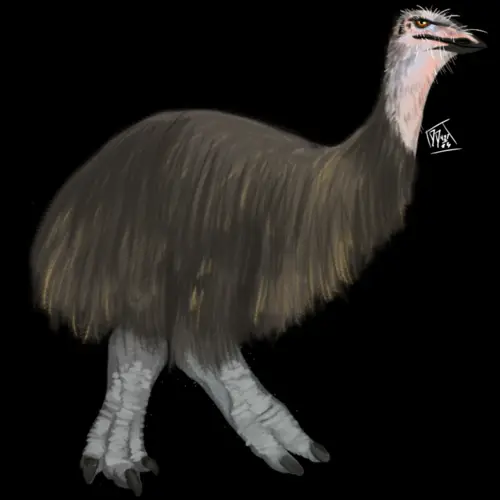
 🎨 Restoration
Restoration: Pagodroma721 · CC BY-SA 4.0 · Wikimedia Commons Source
Life restorations are artistic reconstructions based on fossil evidence; true coloration and soft-tissue details remain uncertain.
Aepyornis
Aepyornis maximus (Aepyornis · Aepyornis)
Known only from fossils. The IUCN Red List assesses only species extant since 1500 CE, so fossil taxa are not assigned a category.
💡 Everyday Comparisons for Size, Mass & Speed
- 💡 Its height of 3 m is about 1.8 times that of an adult human about 1.7 m tall (Comparison).
- 💡 Its egg length of 34 cm is more than 5 times that of a chicken egg (about 6 cm) (Comparison). Canterbury Museum in New Zealand holds an elephant bird egg donated in 1911 (half of it pieced together from shell fragments) in its collection storage.
Reference standards: coach bus ~12 m, mid-size car ~4.9 m, compact car ~1 t, basketball hoop 3.05 m, credit card 8.56 cm.
Site-computed relative index from recorded values; not a formal scientific metric.
📖 1. Overview
Aepyornis maximus (the elephant bird) is a giant flightless bird that lived in Madagascar, belonging to the ratite group along with ostriches, emus, and moas. It went extinct about 1,000 years ago.
🦴 2. Anatomy & Morphology
Fossil studies estimate that the largest individuals reached 3 m in height and 540 kg in weight. Its eggs were also the largest of any bird, growing up to 34 cm long and 24.5 cm wide.
🔍 3. Fossil Record & Paleoecology
A 2018 study of its sensory organs concluded that rather than foraging by day like moas, it was nocturnal like kiwis. Among living relatives, its closest relatives are the kiwis of New Zealand.
🇰🇷 4. Connection to Korea
No direct record connecting this species to Korea has been found.
📚 Sources & References
- • Fossil taxon — the IUCN Red List assesses only species living or extinct since 1500
- • paleobiodb.org — basicTaxonInfo
- • wikidata.org — Q11179834
- • commons.wikimedia.org — File:Aepyornis maximus.jpg
- • canterburymuseum.com — a-big-birds-egg
- • Silhouette: PhyloPic — Darren Naish (vectorize by T. Michael Keesey) · CC BY 3.0
Recorded dimensions are widely cited representative estimates from public literature and may vary by study or specimen.