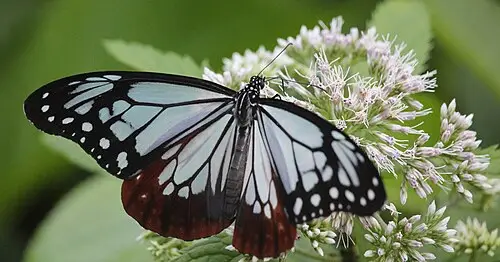
 📸 Photo
Photo: Alpsdake · CC BY-SA 4.0 · Wikimedia Commons Source
Chestnut tiger
Parantica sita (Chestnut tiger · アサギマダラ)
Not Evaluated (NE) on the IUCN Red List yet.
💡 Everyday Comparisons for Size, Mass & Speed
- 💡 A wingspan of 105 mm is about 2 cm longer than the long side of a credit card (85.6 mm) (Comparison).
- 💡 According to the National List of Species of Korea, it is native to Jeju Island, but its strong migratory ability allows it to be seen in central Korea during summer as well.
Reference standards: coach bus ~12 m, mid-size car ~4.9 m, compact car ~1 t, basketball hoop 3.05 m, credit card 8.56 cm.
📖 1. Overview
The chestnut tiger is the largest milkweed butterfly in the family Nymphalidae found in Korea; it is native to Jeju Island and highly migratory, so it is also observed in central Korea in summer.
🦴 2. Anatomy & Morphology
Its wingspan is 88–105 mm. The upper forewings have many white markings on a black-bordered background, while the hindwings have white markings spreading from the center to the base on a pale brown background. Males have a blackish-brown patch of sex scales near the outer margin of the upper hindwing.
🔍 3. Ecology & Behavior
It produces 2–3 generations a year, with the spring form appearing in May–June and the summer form in July–September. Its host plants are Metaplexis japonica, Cynanchum wilfordii, Cynanchum atratum, and Cynanchum auriculatum in Asclepiadoideae, as well as Aristolochia manshuriensis in Aristolochiaceae.
🇰🇷 4. Connection to Korea
The National List of Species of Korea records its domestic distribution as Jeju Island and notes that because of its strong migratory habit, it is also observed in various parts of central Korea in summer.
📚 Sources & References
- • IUCN Red List: not evaluated (NE) — cross-checked with the Wikidata conservation-status entry
- • catalogueoflife.org — 4D6SJ
- • 국가생물종목록(국립생물자원관) ktsn 120000035845 — https://species.nibr.go.kr/home/mainHome.do?cont_link=009&subMenu=009002&contCd=009002&ktsn=120000035845
- • wikidata.org — Q707043
- • commons.wikimedia.org — File:Parantica sita (feeding nectar s7).JPG
- • species.nibr.go.kr — mainHome.do
- • Silhouette: PhyloPic — Mattia Menchetti · CC0 1.0 (Related taxon silhouette — Erebia)
Recorded dimensions are widely cited representative estimates from public literature and may vary by study or specimen.