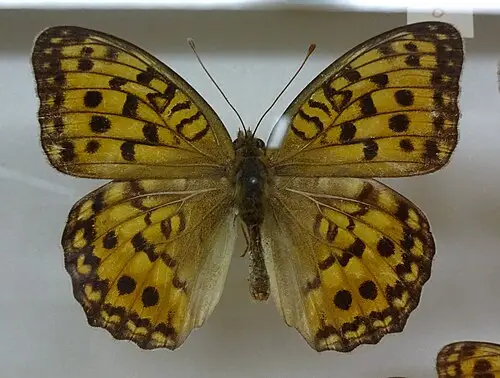
 📸 Photo
Photo: コミスジ空港 · CC BY-SA 4.0 · Wikimedia Commons Source
Fabriciana nerippe
Fabriciana nerippe (Fabriciana nerippe · オオウラギンヒョウモン)
Not Evaluated (NE) on the IUCN Red List yet.
🇰🇷 Class II endangered wildlife (Korea)
💡 Everyday Comparisons for Size, Mass & Speed
- 💡 Its maximum wingspan of 68 mm is about 2.6 times the diameter of a Korean 500-won coin (26.5 mm) (Comparison).
- 💡 It sips nectar from flowers common along roadsides and mountain foothills, such as daisy fleabane and thistle. When grasslands turn into forests, the places where this butterfly lives shrink.
Reference standards: coach bus ~12 m, mid-size car ~4.9 m, compact car ~1 t, basketball hoop 3.05 m, credit card 8.56 cm.
📖 1. Overview
Fabriciana nerippe is the largest fritillary butterfly, living in mountain grasslands and along forest edges. It is a Class II endangered wildlife (Korea).
🦴 2. Anatomy & Morphology
Its wingspan is 53–68 mm, with black markings on orange wings and silver spots on the underside of the hindwings. Females are larger than males and have a darker background color.
🔍 3. Ecology & Behavior
It has 1 generation per year, appearing from May, peaking in June and July, estivating through summer, and emerging again in September. Females lay eggs until early October, larvae overwinter, and adults feed on nectar from daisy fleabane, loosestrife, and thistle flowers.
🇰🇷 4. Connection to Korea
It is a Class II endangered wildlife (Korea). Distributed only in limited areas such as Gangwon-do, Gyeonggi-do, parts of Gyeongsangbuk-do, and Incheon, it is thought to be affected by shrinking grasslands as mountains become forested and by climate change.
📚 Sources & References
- • 멸종위기 야생생물 Ⅱ급 — 국가생물종목록(국립생물자원관) ktsn 120000121401 — https://species.nibr.go.kr/home/mainHome.do?cont_link=009&subMenu=009002&contCd=009002&ktsn=120000121401
- • IUCN Red List: not evaluated (NE) — cross-checked with the Wikidata conservation-status entry
- • Korean protection status: Class II endangered wildlife (Korea)
- • catalogueoflife.org — 3DR62
- • 국가생물종목록(국립생물자원관) ktsn 120000121401 — https://species.nibr.go.kr/home/mainHome.do?cont_link=009&subMenu=009002&contCd=009002&ktsn=120000121401
- • wikidata.org — Q5974384
- • commons.wikimedia.org — File:252-Fabriciana nerippe.JPG
- • nie.re.kr — view.do
- • bok.or.kr — contents.do
- • Silhouette: PhyloPic — Didier Descouens · CC BY 4.0 (Congeneric silhouette — Fabriciana niobe)
Recorded dimensions are widely cited representative estimates from public literature and may vary by study or specimen.