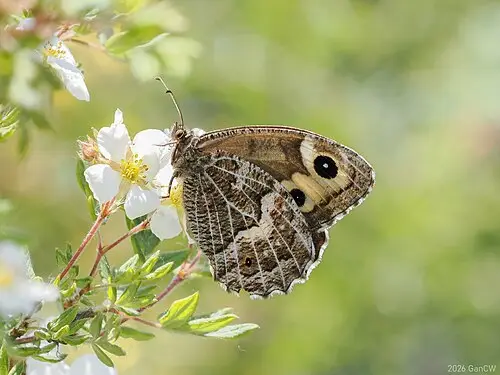
 📸 Photo
Photo: Cheongweei Gan · CC BY 4.0 · Wikimedia Commons Source
Hipparchia autonoe
Hipparchia autonoe (Hipparchia autonoe · Hipparchia autonoe)
Not Evaluated (NE) on the IUCN Red List yet.
🇰🇷 Class I endangered wildlife (Korea) · Natural Monument (Korea) «Hipparchia autonoe»
💡 Everyday Comparisons for Size, Mass & Speed
- 💡 Its maximum wingspan of 60 mm is about 2.3 times the diameter of a Korean 500-won coin (26.5 mm) (Comparison).
- 💡 The shrinking of its habitat as high-elevation grasslands on Hallasan become covered with dwarf bamboo under a changing climate illustrates how global warming affects mountain-top organisms.
Reference standards: coach bus ~12 m, mid-size car ~4.9 m, compact car ~1 t, basketball hoop 3.05 m, credit card 8.56 cm.
📖 1. Overview
Hipparchia autonoe is a butterfly living only at elevations of 1,300 m or higher on Hallasan in Jeju Island, and is both a Class I endangered wildlife (Korea) and a Natural Monument (Korea).
🦴 2. Anatomy & Morphology
Its wingspan is 56–60 mm, and the upper surface of the wings is blackish-brown with 2 snake-eye-like black spots on the outer part connected to a white band. Females are larger than males and have a thicker abdomen.
🔍 3. Ecology & Behavior
It appears once a year in July and August, and females lay eggs one by one on the leaves of host plants. Adults feed on nectar from thyme, scabious, lousewort, and self-heal flowers and often rest on volcanic rocks, while larvae eat grasses (fescue).
🇰🇷 4. Connection to Korea
It is a Class I endangered wildlife (Korea) and was designated a Natural Monument (Korea) in 2005. In Korea it is seen only in grasslands at 1,300 m or higher on Hallasan, where the rapid spread of dwarf bamboo is reducing its host plants.
📚 Sources & References
- • 멸종위기 야생생물 Ⅰ급 · 천연기념물 «산굴뚝나비» — 국가생물종목록(국립생물자원관) ktsn 120000035769 — https://species.nibr.go.kr/home/mainHome.do?cont_link=009&subMenu=009002&contCd=009002&ktsn=120000035769
- • IUCN Red List: not evaluated (NE) — cross-checked with the Wikidata conservation-status entry
- • Korean protection status: Class I endangered wildlife (Korea) · Natural Monument (Korea) «Hipparchia autonoe»
- • catalogueoflife.org — 3LYXH
- • 국가생물종목록(국립생물자원관) ktsn 120000035769 — https://species.nibr.go.kr/home/mainHome.do?cont_link=009&subMenu=009002&contCd=009002&ktsn=120000035769
- • heritage.go.kr — culSelectDetail.do
- • wikidata.org — Q12599968
- • nie.re.kr — view.do
- • heritage.go.kr — cul 1369904580000.html
- • bok.or.kr — contents.do
- • Silhouette: PhyloPic — Mattia Menchetti · CC0 1.0 (Related taxon silhouette — Erebia)
Recorded dimensions are widely cited representative estimates from public literature and may vary by study or specimen.