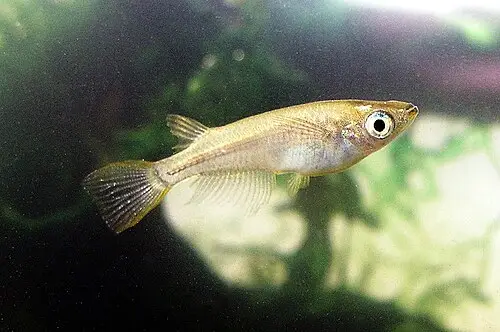
 📸 Photo
Photo: NOZO · CC BY 3.0 · Wikimedia Commons Source
Japanese rice fish
Oryzias latipes (Japanese rice fish · ミナミメダカ)
💡 Everyday Comparisons for Size, Mass & Speed
- 💡 Seen in rice paddies, ponds, and small lowland waterways, it is a fish for which FishBase lists 'paddy fields' as a habitat.
- 💡 Easy to keep in home aquariums, it is raised at home and is also used in laboratory research.
- 💡 Its maximum body length of 4 cm is about 1.5 times the diameter of a Korean 500-won coin (2.65 cm) (Comparison).
Reference standards: coach bus ~12 m, mid-size car ~4.9 m, compact car ~1 t, basketball hoop 3.05 m, credit card 8.56 cm.
📖 1. Overview
The Japanese rice fish is a small freshwater fish around 4 cm long that lives in schools near the surface of rice paddies, ponds, and slow streams.
🦴 2. Anatomy & Morphology
Its body is streamlined and laterally compressed, with the dorsal fin set close to the caudal peduncle. The base of the anal fin is long with a serrated outer margin, and the dark spot on the rear flank becomes darker during the spawning season.
🔍 3. Ecology & Behavior
It is active during the day and feeds mainly on zooplankton. Its spawning season is May–July, and it lays eggs in the early morning.
🇰🇷 4. Connection to Korea
In Korea, it is listed on the National List of Species of Korea as living in lower reaches of rivers flowing into the East Sea, the Nakdong River, the Tamjingang River, and islands of the West and South Seas.
📚 Sources & References
- • IUCN Red List LC (2019) — https://www.iucnredlist.org/species/166979/1159322
- • IUCN Red List category LC — latest assessment at iucnredlist.org
- • catalogueoflife.org — 6SZHL
- • iucnredlist.org — 1159322
- • 국가생물종목록(국립생물자원관) ktsn 120000057930 — https://species.nibr.go.kr/home/mainHome.do?cont_link=009&subMenu=009002&contCd=009002&ktsn=120000057930
- • wikidata.org — Q1142975
- • commons.wikimedia.org — File:Nihonmedaka.jpg
- • fishbase.se — Oryzias-latipes.html
- • species.nibr.go.kr — list
- • Silhouette: PhyloPic — author not recorded · CC0 1.0
Recorded dimensions are widely cited representative estimates from public literature and may vary by study or specimen.