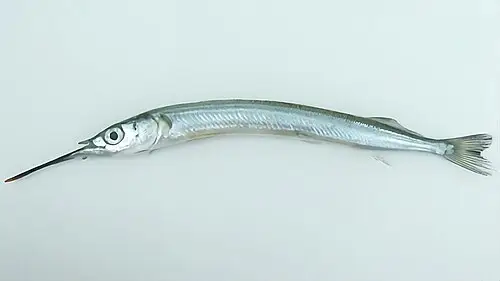
 📸 Photo
Photo: Kwun H, Park J, Kim H, Kim J, Park H (2017) Checklist of the tidal pool fishes of Jeju Island, Korea. ZooKeys 709: 135-154. https://doi.org/10.3897/zookeys.709. · CC BY 4.0 · Wikimedia Commons Source
Japanese halfbeak
Hyporhamphus sajori (Japanese halfbeak · サヨリ)
💡 Everyday Comparisons for Size, Mass & Speed
- 💡 Its maximum length of 40 cm is nearly the same as the long side of an A3 sheet of paper (42 cm) (Comparison).
- 💡 FishBase notes that its flesh is tasty and that it is caught commercially as well as with dip nets. According to the National List of Species of Korea, it can be found along all Korean coasts.
Reference standards: coach bus ~12 m, mid-size car ~4.9 m, compact car ~1 t, basketball hoop 3.05 m, credit card 8.56 cm.
📖 1. Overview
The Japanese halfbeak is a marine fish of the family Hemiramphidae (order Beloniformes) with a slender, elongated body like a saury. It lives in schools near the surface inside bays and also ascends into river estuaries.
🦴 2. Anatomy & Morphology
Its snout is very pointed and the lower jaw projects far forward with a bright red tip. The back is bluish-green, the belly is silvery, and the flesh is translucent.
🔍 3. Ecology & Behavior
It feeds mainly on small crustaceans and zooplankton. From April to July it attaches its eggs to coastal seaweeds, and it occasionally leaps above the water surface.
🇰🇷 4. Connection to Korea
The National List of Species of Korea records it as occurring along all coasts of Korea.
📚 Sources & References
- • IUCN Red List LC (2025) — https://www.iucnredlist.org/species/67868700/67871790
- • IUCN Red List category LC — latest assessment at iucnredlist.org
- • catalogueoflife.org — 3NYF9
- • iucnredlist.org — 67871790
- • 국가생물종목록(국립생물자원관) ktsn 120000057954 — https://species.nibr.go.kr/home/mainHome.do?cont_link=009&subMenu=009002&contCd=009002&ktsn=120000057954
- • wikidata.org — Q2210199
- • commons.wikimedia.org — File:Hyporhamphus sajori.jpg
- • fishbase.se — Hyporhamphus-sajori.html
- • species.nibr.go.kr — mainHome.do
- • Silhouette: PhyloPic — Lily Hughes · CC0 1.0 (Congeneric silhouette — Hyporhamphus (Hyporhamphus))
Recorded dimensions are widely cited representative estimates from public literature and may vary by study or specimen.