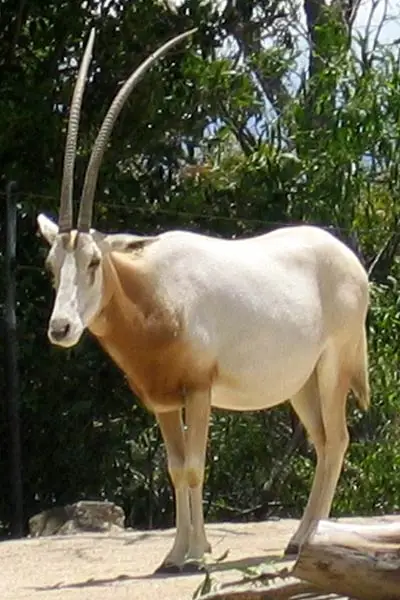
 📸 Photo
Photo: Albinfo · CC BY-SA 3.0 · Wikimedia Commons Source
Scimitar-horned Oryx
Oryx dammah (Scimitar-horned Oryx · シロオリックス)
💡 Everyday Comparisons for Size, Mass & Speed
- 💡 Its white coat acts like a natural cooling suit that reflects desert heat (Smithsonian's National Zoo).
- 💡 A maximum weight of 210 kg equals ten and a half 20 kg bags of rice (Comparison).
- 💡 Unlike livestock, it can survive for months or even years without drinking water by extracting moisture from the plants it eats (Smithsonian's National Zoo).
Reference standards: coach bus ~12 m, mid-size car ~4.9 m, compact car ~1 t, basketball hoop 3.05 m, credit card 8.56 cm.
Site-computed relative index from recorded values; not a formal scientific metric.
📖 1. Overview
The Scimitar-horned Oryx is a white antelope of the Sahara region that vanished from the wild due to hunting, drought, and overgrazing before reintroduction efforts began in countries such as Tunisia.
🦴 2. Anatomy & Morphology
Its mostly white body with reddish-brown markings on the neck and face reflects desert heat. Black skin and a black tongue tip protect against sunburn, wide hooves help it walk on sand, and long scimitar-like horns curve backward.
🔍 3. Ecology & Behavior
Eating grasses, herbs, juicy roots, and buds, it can go for months or even years without drinking water by getting moisture from plants. It migrates long distances in search of fresh grass.
🇰🇷 4. Connection to Korea
No direct record connecting this species to Korea has been found.
📚 Sources & References
- • IUCN Red List EN (2023) — https://www.iucnredlist.org/species/15568/197393805
- • IUCN Red List category EN — latest assessment at iucnredlist.org
- • mammaldiversity.org — 1006238
- • iucnredlist.org — 197393805
- • wikidata.org — Q369817
- • commons.wikimedia.org — File:Oryx Dammah.jpg
- • nationalzoo.si.edu — scimitar-horned-oryx
- • animaldiversity.org — Oryx dammah
- • Silhouette: PhyloPic — Matthew Speight · CC0 1.0
Recorded dimensions are widely cited representative estimates from public literature and may vary by study or specimen.