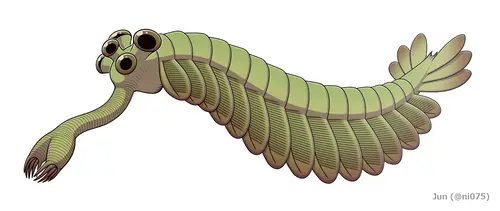
 🎨 Restoration
Restoration: Junnn11 · CC BY-SA 4.0 · Wikimedia Commons Source
Life restorations are artistic reconstructions based on fossil evidence; true coloration and soft-tissue details remain uncertain.
Opabinia
Opabinia regalis (Opabinia · オパビニア・レガリス)
Known only from fossils. The IUCN Red List assesses only species extant since 1500 CE, so fossil taxa are not assigned a category.
💡 Everyday Comparisons for Size, Mass & Speed
- 💡 Its maximum body length of 7 cm (excluding the proboscis) is about 2.6 times the diameter of a Korean 500-won coin (about 2.65 cm) (Comparison).
- 💡 In the Walcott Quarry fossil assemblage, Opabinia regalis makes up only 0.006%, making it a rare animal at roughly 0.6 individuals per 10,000 (Calculation).
Reference standards: coach bus ~12 m, mid-size car ~4.9 m, compact car ~1 t, basketball hoop 3.05 m, credit card 8.56 cm.
📖 1. Overview
Opabinia regalis was a small, bizarre animal with five eyes from the Cambrian Burgess Shale. Its fossils are very rare, with only 42 specimens known across all collections combined.
🦴 2. Anatomy & Morphology
Its head bore four stalked eyes and one large central eye, along with a flexible proboscis 4 times the length of the head ending in a spiny claw. The body had 15 segments, each with lateral lobes, plus a tail fan, and its mouth faced backward.
🔍 3. Fossil Record & Paleoecology
It is thought to have swum by undulating its lateral lobes and steered with its tail fan. Researchers interpret it as a predator that caught prey with the claw at the tip of its flexible proboscis and brought it to its mouth.
🇰🇷 4. Connection to Korea
No direct record connecting this species to Korea has been found.
📚 Sources & References
- • Fossil taxon — the IUCN Red List assesses only species living or extinct since 1500
- • paleobiodb.org — basicTaxonInfo
- • wikidata.org — Q50570
- • commons.wikimedia.org — File:20191108 Opabinia regalis.png
- • burgess-shale.rom.on.ca — opabinia-regalis
- • Silhouette: PhyloPic — Nobu Tamura (vectorized by T. Michael Keesey) · CC BY 3.0
Recorded dimensions are widely cited representative estimates from public literature and may vary by study or specimen.