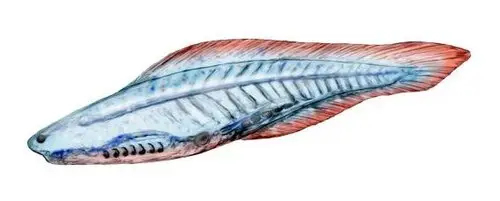
 🎨 Restoration
Restoration: Nobu Tamura email:nobu.tamura@yahoo.com www.palaeocritti.com · CC BY-SA 3.0 · Wikimedia Commons Source
Life restorations are artistic reconstructions based on fossil evidence; true coloration and soft-tissue details remain uncertain.
Haikouichthys
Haikouichthys ercaicunensis (Haikouichthys · Haikouichthys)
Known only from fossils. The IUCN Red List assesses only species extant since 1500 CE, so fossil taxa are not assigned a category.
💡 Everyday Comparisons for Size, Mass & Speed
- 💡 Humans, birds, reptiles, mammals, amphibians, and fishes are all vertebrates, and Haikouichthys is explained as being close to the last common ancestor of all these animals.
- 💡 Because it took over 100 million years for jaws to evolve, the jaws we use to chew food today appeared much later than this fish (commentary from the Natural History Museum in London).
Reference standards: coach bus ~12 m, mid-size car ~4.9 m, compact car ~1 t, basketball hoop 3.05 m, credit card 8.56 cm.
📖 1. Overview
Haikouichthys ercaicunensis (genus Haikouichthys) was an early jawless fish that lived in Cambrian seas about 518 million years ago, introduced by the Natural History Museum in London as the oldest fish and probably the oldest vertebrate.
🦴 2. Anatomy & Morphology
Although it lacked jaws, the distinctive arrangement of its gills and muscle segments (myomeres) shows that it was a fish.
🔍 3. Fossil Record & Paleoecology
It was discovered in 1999 at the Chengjiang fossil site in China alongside another early fish, Myllokunmingia. This period overlaps with the Cambrian explosion, when most animal body plans first appeared.
🇰🇷 4. Connection to Korea
No direct record connecting this species to Korea has been found.
📚 Sources & References
- • Fossil taxon — the IUCN Red List assesses only species living or extinct since 1500
- • paleobiodb.org — basicTaxonInfo
- • wikidata.org — Q20718369
- • commons.wikimedia.org — File:Haikouichthys NT.jpg
- • nhm.ac.uk — prehistoric-fish-timeline.html
- • pmc.ncbi.nlm.nih.gov — PMC2842668
- • Silhouette: PhyloPic — Scott Hartman · CC0 1.0 (Related taxon silhouette — Myllokunmingia fengjiaoa)
Recorded dimensions are widely cited representative estimates from public literature and may vary by study or specimen.